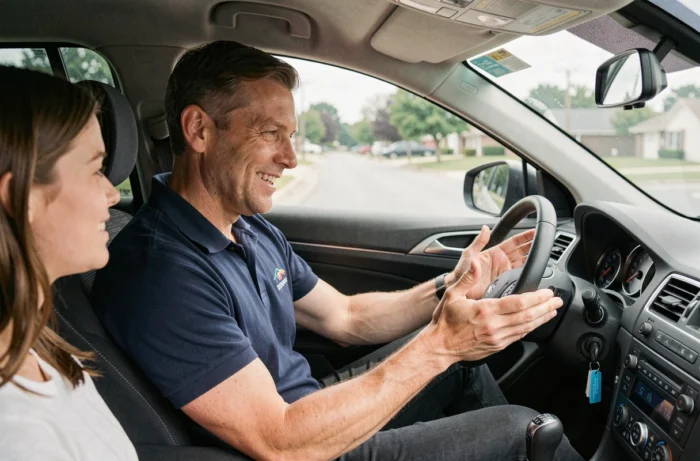
Becoming a driving school instructor in 2026 requires validating a professional title structured in skill blocks, obtaining a renewable prefectural authorization, and choosing a working framework (employee or independent). These three parameters involve different timelines, costs, and administrative constraints. This article compares the pathways and highlights the friction points that most job descriptions do not detail.
CCP1, CCP2, and the ECSR professional title: compared durations and contents
The professional title of driving and road safety instructor (ECSR) is divided into two certificates of professional competence. Each covers a distinct scope and can be obtained separately, paving the way for a modular pathway.
| Block | Main Content | Immediate Outcome |
|---|---|---|
| CCP1 | Training of apprentice drivers (Category B driving, pedagogy in dual-control vehicles) | Temporary and restrictive authorization to practice (ATRE) possible upon validation |
| CCP2 | Awareness of road safety, conducting group lessons, prevention actions | Completes CCP1 to obtain the full ECSR professional title |
| Full ECSR Title | Validated CCP1 + CCP2 | Teaching authorization issued by the prefect, valid for 5 years |
The complete training generally lasts several months. Some centers offer a curriculum of 945 hours spread over about 9 months, depending on the pace of the organization. This volume includes theoretical courses, practical situations, and internships in driving schools.
The benefit of the division into two blocks is tangible: a candidate who validates CCP1 can request an ATRE and start teaching car driving under certain conditions, without waiting for the completion of the full pathway. This mechanism reduces the time before the first income.
To delve deeper into the details of administrative prerequisites and outcomes, 1 Emploi’s resources detail each step of the regulatory pathway.
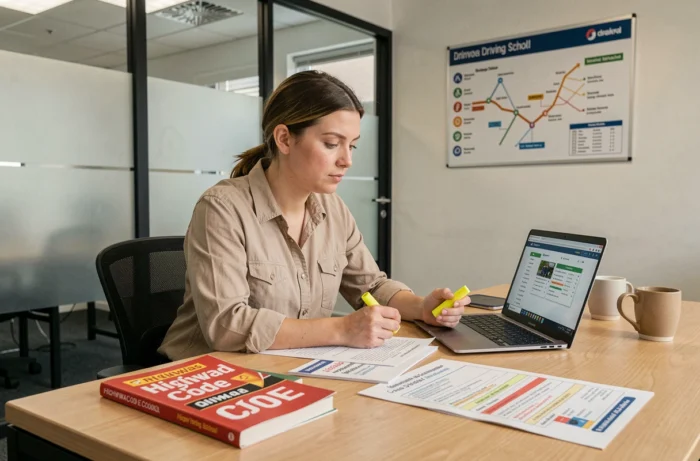
Access conditions for the driving instructor profession: what has changed
Regulatory conditions have recently evolved. The decree n° 2025-1437 of December 31, 2025 updated the framework of the Highway Code regarding the teaching authorization.
The most notable change concerns the minimum age. Since 2026, it is no longer necessary to be 20 years old to obtain the teaching authorization. The determining condition is now to have completed the probationary period of the Category B license. This evolution broadens access to the profession for candidates who obtained their license early through accompanied driving.
The other conditions remain stable:
- Hold a valid Category B license, outside the probationary period
- Not have been subject to certain convictions (criminal record check)
- Justify the required medical fitness for teaching driving
- Have obtained the ECSR professional title or an equivalent recognized diploma
The teaching authorization is issued by the prefect and must be renewed every 5 years. This renewal requires meeting the medical and administrative conditions again. A failure to renew prohibits practice, even for an experienced instructor.
Employee or independent driving school instructor: two distinct realities
Working as an employee in an existing driving school and operating under one’s own brand do not fall under the same legal framework. This distinction has direct financial and administrative consequences.
Employee or collaborator practice
The employee instructor is employed by an already accredited driving school. They only need their teaching authorization. The prefectural approval of the establishment covers their activity. This is the quickest pathway to start practicing after obtaining the ECSR title.
Independent practice with prefectural approval
An instructor wishing to operate under their own brand must obtain a distinct prefectural approval to operate a driving school. This approval pertains to the business itself, not just the individual.
Additional obligations include:
- Having compliant premises and at least one dual-control vehicle
- Taking out mandatory professional insurance
- Choosing an appropriate legal status (micro-enterprise, classic sole proprietorship, or company)
- Managing social declarations, particularly with Urssaf
The micro-entrepreneur status is appealing due to its administrative simplicity. However, it caps revenue and does not allow the deduction of actual expenses (vehicle, fuel, insurance), which can heavily impact the profitability of an activity with high fixed costs.
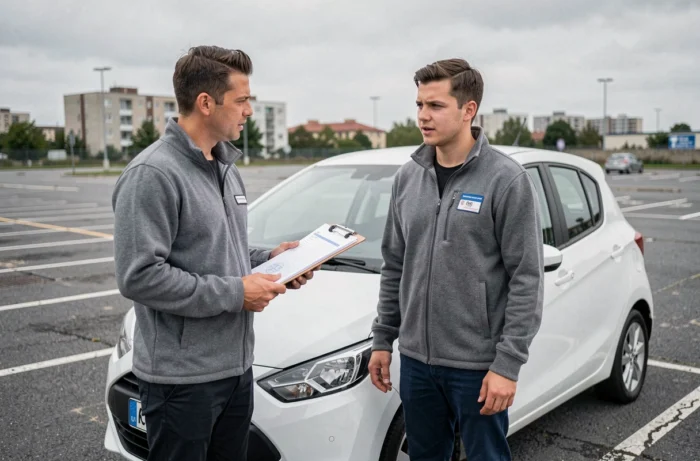
ECSR training: criteria for choosing a training center
The choice of training center determines both the quality of preparation and financing options. Not all organizations offer the same number of hours or the same support towards employment.
A non-negotiable criterion is the RNCP certification of the ECSR professional title. Without it, the diploma issued does not allow obtaining the teaching authorization. Verifying that the organization is authorized by a recognized certifier prevents undertaking a training that lacks regulatory value.
The duration of the curriculum varies by center. Some concentrate training over a few intensive months, while others spread it over a year with longer internship periods. The volume of practical experience (hours spent in a vehicle with students) remains the most discriminating factor for success in the professional title exams.
Financing is another point of consideration. The ECSR title being registered with the RNCP, it is eligible for CPF and certain retraining schemes (Transitions Pro, regional aids). The cost of training represents several thousand euros, making financial arrangements crucial for many candidates in retraining.
The profession of driving instructor remains accessible without a university degree, provided that the probationary period is completed and the ECSR training is followed in an authorized center. The distinction between teaching authorization and establishment approval remains the least understood point by candidates, yet it most directly determines the daily practice framework.