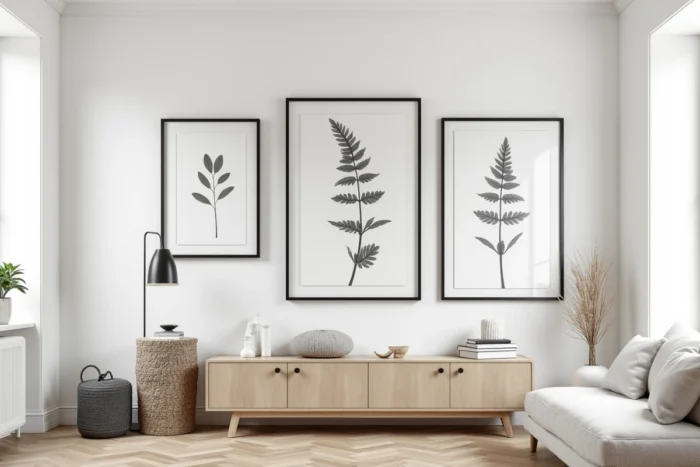
Five identical frames, a white wall, and the certainty that the result will resemble a waiting room. We all know that hesitation, tape measure in hand, to mark pencil points before putting down the hammer. The problem is not the number of frames; it’s the lack of bias in the arrangement. With strictly identical frames, every centimeter of difference or alignment is noticeable, making the choice of layout crucial.
Classic configurations (straight line, symmetrical grid) are covered everywhere. Here, we focus on five less conventional arrangements that precisely exploit the uniformity of the frames to create a true decorative effect, whether in the living room, a bedroom, or along a hallway.
1. Ascending diagonal arrangement along a staircase or visual slope
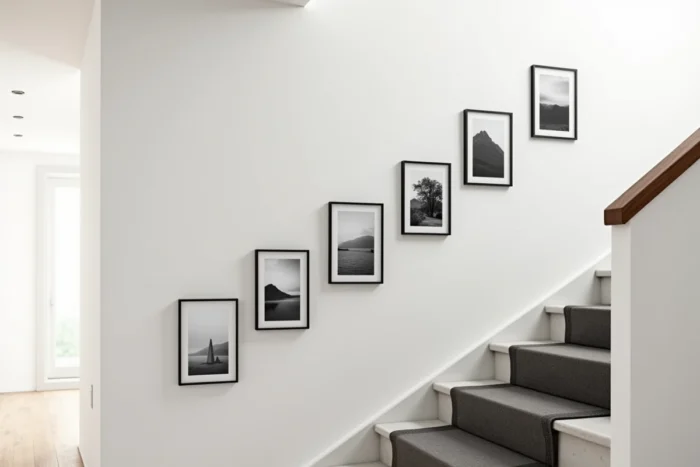
A staircase wall remains one of the most underutilized surfaces. Instead of following the slope of the railing with frames of varying sizes, here we use five identical frames spaced evenly, with the center of each frame following the upward line. The result guides the eye upward without creating a break.
To set the angle, first draw an imaginary line parallel to the slope of the staircase, then position the center of each frame on this line with a constant spacing (the width of a closed fist works well as a quick reference). If the wall is narrow, tighten the spacing slightly to prevent the outer frames from being too close to the corners.
This arrangement also works on a flat wall, without a staircase, to simulate an upward movement in a hallway or a slightly low-ceilinged entryway. You can also find tips for arranging 5 frames on a wall that detail variations of this approach based on the available height.
2. Offset cross composition to break expected symmetry
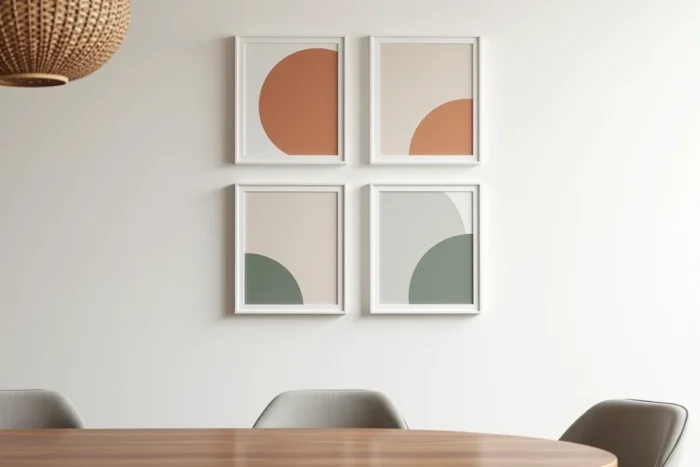
The classic cross (one central frame, one above, one below, one to the left, one to the right) is geometrically perfect, and that’s its flaw: it appears rigid. The idea here is to slightly offset one or two frames from the cross to introduce controlled visual tension.
Specifically, keep the central frame and two side frames aligned horizontally. The remaining two frames are positioned above and below the center but offset by half their width to the right (or left). The composition remains readable as a cross, but the slight imbalance draws attention and gives a more contemporary character.
This arrangement is particularly suitable above a sofa or an entry console. Feedback varies on this point, but a spacing of a few centimeters between each frame is enough for the whole to breathe without appearing scattered.
3. Low band above a piece of furniture to anchor the composition
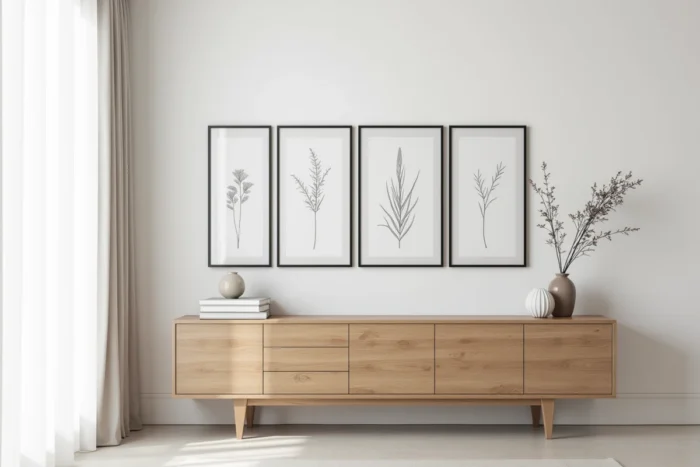
Most guides recommend placing the center of the frames at eye level. With a low piece of furniture (sideboard, console, entry bench), this rule often creates an awkward gap between the top of the furniture and the bottom of the frames. Lowering the composition so that the bottom edge of the frames is close to the furniture creates a coherent visual block.
Align the five frames in a single horizontal line, tightly spaced, with minimal space between them. The bottom edge of the frames should be about fifteen centimeters above the surface of the furniture. The whole works like a frieze that extends the furniture upward.
This low band is particularly effective in a dining room or living room where the gaze naturally falls on the furniture-wall area. The series effect created by the identical frames enhances the impression of an orderly collection.
4. Hanging on a picture rail for an evolving composition
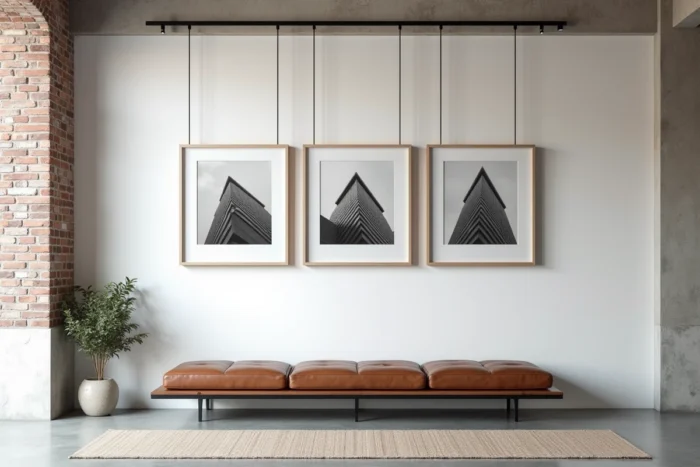
Drilling five perfectly spaced holes in drywall is the best way to discover that one hole is off by a centimeter once all the frames are hung. The picture rail (or gallery rail) eliminates this problem. You fix a single horizontal rail, then the frames slide along adjustable cables or rods.
- Each frame can be repositioned without drilling new holes, allowing you to test several spacings before finalizing the arrangement
- The metal cable adds a vertical line that gives an art gallery effect even in a small space
- You can temporarily remove a frame (to change the photo, clean the glass) without touching the others
This system is particularly suitable when you are still unsure about the arrangement or when you plan to change the contents of the frames. The rail is installed at the junction of the wall and ceiling or a few centimeters below, and the cables drop to the desired height.
5. Arc arrangement to dress an angle or recess
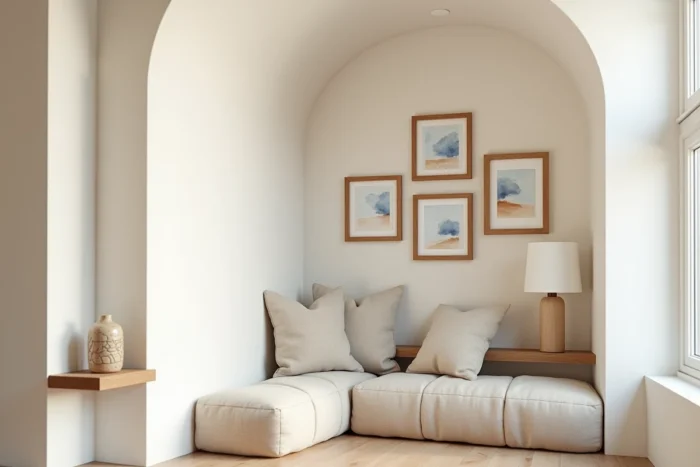
Not all walls are perfect rectangles. Above a curved door, in an alcove, or around a round mirror, arranging the five frames in a semicircle follows the existing curve instead of fighting against it.
Start by drawing an arc with a pencil (a nail, string, and pencil suffice as a makeshift compass). The centers of the five frames are spaced evenly along this arc. The two outer frames are slightly tilted to follow the curvature, which requires adjustable fixings or simply a nail driven a bit higher on one side.
This arrangement also works on a flat wall, without a curved architectural element, to create an organic movement. Above a headboard, for example, the arc brings a softness that a straight line does not produce. The spacing between the frames should remain constant for the curve to be readable.
The choice of arrangement depends as much on the wall as on the furniture below. An identical frame repeated five times allows little room for spacing approximations but rewards the care taken in the preliminary layout. Before drilling, cutting five templates from kraft paper to exact dimensions and fixing them to the wall with repositionable tape remains the most reliable method to validate the final effect.