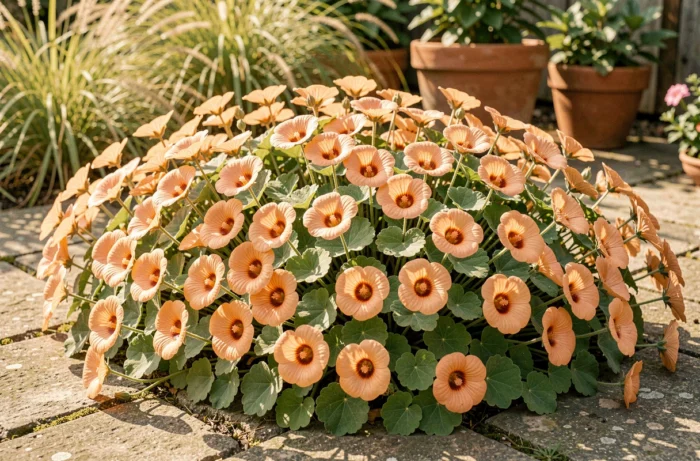
Malvastrum lateritium is a creeping perennial from the Malvaceae family, native to South America. Before planting it, one question deserves to be asked: how does it perform under the real constraints of a garden, from soil type to local climate? The online profiles often remain vague about performance variations depending on growing conditions. This article compares measurable parameters to help you decide if this plant is suitable for your land.
Malvastrum lateritium and European Regulation on Invasive Species
A rarely addressed point in horticultural profiles: regulatory status. Malvastrum lateritium is a vigorous, colonizing plant, which logically raises the question of its invasive potential.
Regulation (EU) No 1143/2014 governs invasive alien species of concern to the European Union. The lists are regularly updated, with horizon scanning analyses published in 2025-2026 to anticipate upcoming additions. Malvastrum lateritium does not appear on any of these lists. Its ornamental cultivation is therefore not subject to the prohibitions on introduction, sale, or planting that affect other species (Japanese knotweeds, ragweed).
Major international registers of introduced or invasive species also do not report this plant. In practice, this means you can find advice on malvastrum lateritium and cultivate it without legal constraints, while keeping in mind that monitoring its expansion in the garden remains necessary.
Comparative Table of Cultivation Requirements for Malvastrum Lateritium
The available sources show notable variations on certain parameters. Here is a summary of the cross-referenced data.
| Parameter | Cross-Referenced Data | Notes |
|---|---|---|
| Height | From 20 cm (spreading habit) to 60-120 cm depending on the source | The discrepancy is explained by the distinction between creeping stems and bushy growth in suitable conditions |
| Exposure | Full sun recommended, tolerates partial shade | One source indicates “all exposures,” but full sun clearly promotes flowering |
| Soil Type | Sandy, loamy, clayey, calcareous | Drainage remains the priority criterion, regardless of type |
| Watering | Low to medium | Very good drought resistance once established |
| Hardiness | Semi-hardy | Withstands moderate frosts, not prolonged harsh winters |
| Flowering | May-July according to some sources, July-September according to others | The period varies depending on regional climate and year of planting |
| Foliage | Evergreen | Dark green, glossy, with the typical rough appearance of Malvaceae |
| Plant Density | 3 plants per m² | Rapid ground coverage |
Flowering of Malvastrum Lateritium: Why Data Diverges
The discrepancy in flowering between sources (May-July versus July-September) is not an error. It reflects a climatic reality. In regions with mild winters (Atlantic coast, Mediterranean), flowering starts as early as the end of May. In continental or high-altitude areas, it shifts to July.
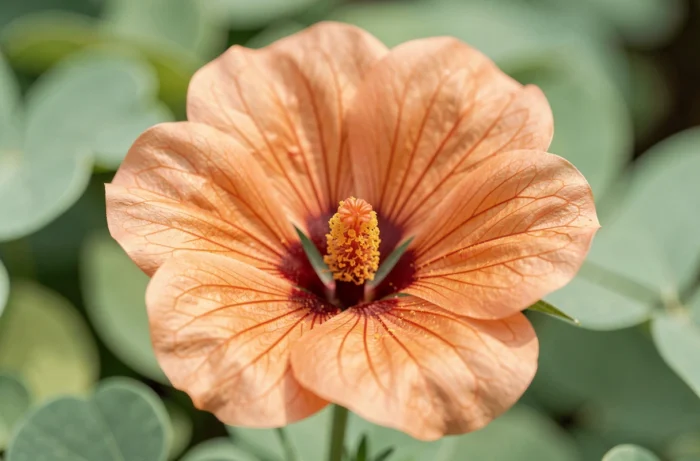
The flowers measure 3 to 5 cm in diameter, featuring five petals in shades ranging from salmon pink to peach, with an orange center. They renew for over a month, which is an asset for ground cover.
The color itself varies according to descriptions: pink, salmon, peach, apricot. These terms actually refer to the same color spectrum. The exact shade depends on sunlight exposure and the maturity of the flower, which slightly fades at the end of its cycle.
Pollinator Plants and Ecological Interest
Malvastrum lateritium produces nectar-rich flowers that attract pollinators. This role is particularly relevant as the plant blooms over an extended period, providing a continuous resource for foraging insects during the summer months.
Calcareous Soil and Dry Soil: The Preferred Terrain of Malvastrum
Among ground-cover perennials, Malvastrum lateritium stands out for its remarkable tolerance to calcareous soil. This parameter is rarely highlighted in general profiles, but it largely determines the success of planting.
- Calcareous Soil: the plant thrives without chlorosis, unlike many acidophilic perennials that yellow in alkaline soil
- Dry and Draining Soil: once established, it withstands dry spells without additional watering, making it suitable for Mediterranean gardens and exposed slopes
- Clayey Soil: acceptable as long as drainage is adequate, excess stagnant water in winter can cause root rot
This versatility explains its frequent use in landscaping projects under urban planning, where maintenance must remain minimal. Coastal gardens also provide a favorable environment, as Malvastrum withstands salt spray and poor sandy soils.
Controlling the Expansion of Malvastrum Lateritium in a Structured Garden
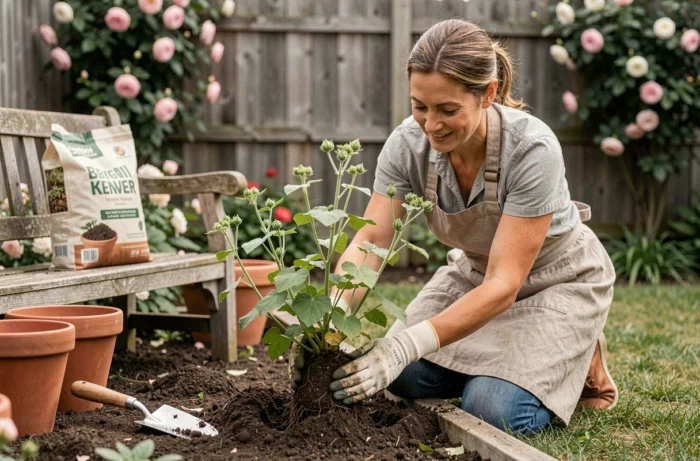
The vigor of this plant is a double-edged sword. Its rapid growth effectively covers bare soil, but it can also colonize unwanted areas. Limiting suckers remains the main maintenance task.
Pruning is done at mid-height when the clump becomes too large. This operation can occur at the end of flowering or early spring. However, in a mixed bed, it is necessary to monitor the advance of stolons towards more delicate neighboring plants.
Preferred Associations
Malvastrum lateritium benefits from being associated with plants of comparable vigor. Ornamental grasses, lavenders, or shrub salvias can withstand its progression without being smothered. Associating it with delicate perennials (small bellflowers, dwarf sedums) requires regular monitoring of the borders.
For a structured garden, planting along a wall, at the top of a slope, or in a clearly defined space with a rhizome barrier remains the simplest configuration to manage. An open and sunny space without fragile neighbors suits it best.
Malvastrum lateritium combines generous flowering, drought resistance, and an absence of regulatory constraints. The most useful data for making a decision remains the soil type: if your land is calcareous and well-drained, this ground-cover perennial will find conditions close to its native South American habitat.