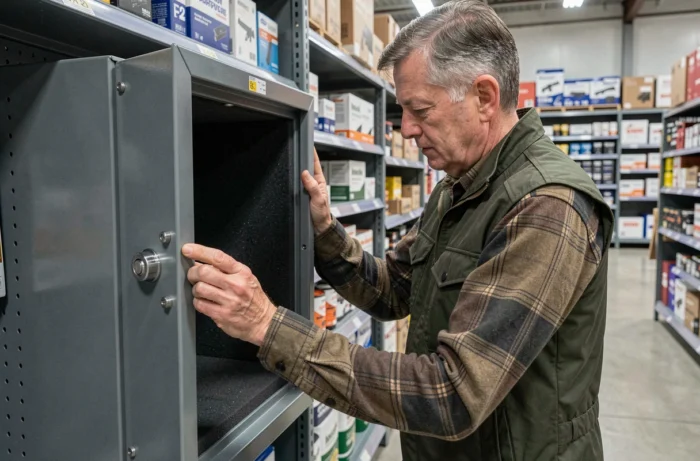
Storing a firearm at home is not just about finding a locked cabinet. Choosing a gun cabinet involves your legal responsibility, the safety of your home, and the long-term preservation of your firearms. At Brico Dépôt, the offer exists, but you need to know how to read a product sheet beyond the displayed price.
Floor or wall mounting: the criterion that product sheets do not explain
You have spotted a compact, lightweight gun cabinet that is easy to install. The problem is that a lightweight cabinet that is not secured can be taken during a burglary. This scenario is not theoretical: field reports indicate thefts where the cabinet was simply moved due to improper sealing.
A cabinet weighing less than 500 kg must be secured to the floor or a load-bearing wall. Most models sold in large DIY stores fall into this weight category. Before purchasing, check two things: is the mounting kit included, and is your wall suitable.
A drywall partition is not sufficient. You need a wall made of concrete blocks, concrete, or solid brick. If your storage room only has lightweight partitions, prioritize floor mounting with chemical anchoring screws. This technical detail determines the compliance of your installation, and it’s better to think about it before choosing a gun cabinet at Brico Dépôt rather than after delivery.
EN 14450 standard and categories of firearms: what the regulations really expect
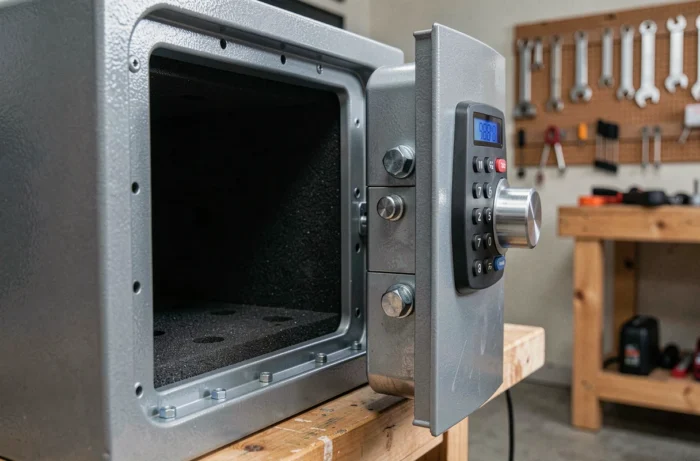
French regulations require firearms to be stored in a secure device. For category B firearms (weapons subject to authorization), the EN 14450 S2 minimum standard is the relevant technical threshold. This standard guarantees resistance to burglary tested in a laboratory, with precise criteria for attack time.
Why is this point so crucial? Because a basic metal cabinet, even equipped with a lock, does not necessarily meet this standard. On a Brico Dépôt product sheet, look for the explicit mention of certification. If it is not present, consider that the cabinet is suitable for storage, not for legal compliance.
Ammunition: a separate compartment is a practical requirement
A point often overlooked in consumer comparisons: ammunition must be stored separately from firearms, in a locked independent compartment. Some cabinets include this compartment. Others do not, which requires purchasing an additional box.
When making your choice, check if the cabinet has a lockable internal compartment. This option avoids an additional purchase and simplifies the daily organization of your storage space.
Electronic or key lock: what locking mechanism for a gun cabinet
Brico Dépôt offers models with electronic locks and steel bolts. This type of locking provides quick access via a code, which is convenient for daily use. In return, it requires batteries and a code that you must remember.
A key lock remains simpler but carries a risk of loss. In both cases, the number of bolts (the metal rods that secure the door in the frame) matters more than the type of lock. The more bolts there are, the more resistant the door is to forced entry.
Here are the elements to compare on product sheets:
- The number of bolts and their diameter, which determine the mechanical resistance of the door
- The thickness of the steel of the casing, expressed in millimeters on serious models
- The presence of a backup lock (physical key in addition to the electronic code)
- The type of hinges, preferably internal to prevent removal
Actual capacity and interior layout: beyond the number of guns advertised
A cabinet advertised for five guns only accommodates them comfortably if your firearms do not have a mounted scope. With optics in place, the space between the supports quickly decreases. Always plan for a capacity that is one or two slots greater than your current need.
The interior layout varies by model. Some offer fixed racks, while others have removable supports that allow you to reorganize the space. If you own both long guns and handguns, a modular model will be more suitable than a single rack.
Depth and height: two measurements to check before ordering
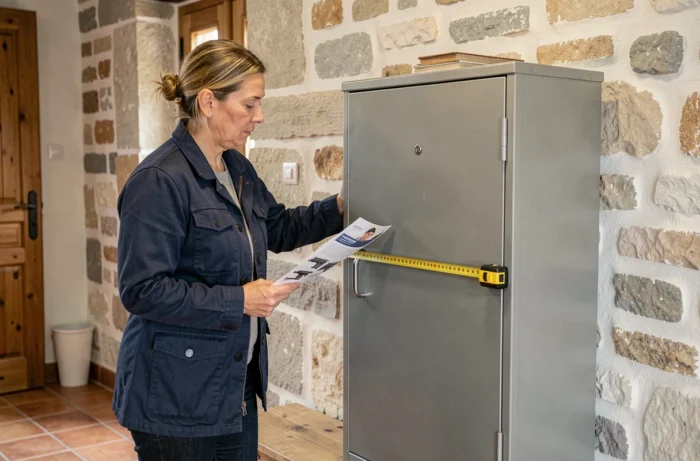
Measure your longest firearms, including the stock. Compare with the usable interior height of the cabinet, not its exterior height. Depth also matters: a cabinet that is too shallow prevents closing if the barrel slightly protrudes.
Also consider the space needed to open the door in the room where you install the cabinet. A narrow hallway can make daily access cumbersome.
Common mistakes to avoid when buying at a DIY store
Buying a gun cabinet at a large DIY store offers a price advantage, but several pitfalls regularly arise:
- Relying solely on the price without checking the product’s compliance certification
- Neglecting the mounting and installing the cabinet simply placed against a wall
- Forgetting the ammunition compartment, which exposes you to non-compliance in case of inspection
- Buying a model exactly suited to the number of current firearms, without margin for future purchases
Proper locking does not just mean closing the door. Field reports show that some owners leave the cabinet closed without actually engaging the bolts. In case of burglary, this negligence can have legal consequences.
Choosing a gun cabinet is as much about regulatory compliance as it is about practical common sense. Check the standard, plan for mounting, anticipate your capacity needs. These three points are enough to avoid most unpleasant surprises after purchase.