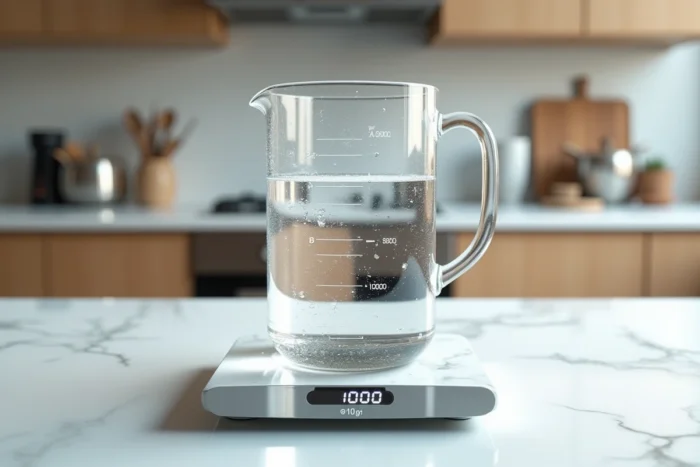
You pour a liter of water into a bottle, place it on a kitchen scale, and the needle shows one kilogram. This almost perfect correspondence between the volume and mass of water simplifies many calculations in daily life. Understanding why it works, and especially when it stops being reliable, helps avoid mistakes in cooking, DIY, or any project that requires precise measurements.
Density of water: the concept behind the conversion
Before talking about liters and kilograms, one must grasp a simple concept. Every material has a density, which is the mass contained in a given volume. For water, this reference value is set at about 1,000 kg/m³ at 4 °C.
In concrete terms, this means that one cubic meter of water weighs one ton. When related to a liter (which is one-thousandth of a cubic meter), we get 1 liter of water weighs about 1 kilogram. This relationship is so convenient that it serves as the basis for most quick conversions.
Have you ever noticed that cooking recipes use “1 liter” and “1 kg” interchangeably for water? This is precisely because the correspondence between 1 liter of water in kg is accurate enough for everyday use.
Be careful not to confuse two similar terms. Density is expressed in kg/m³ (or kg/L). Density, on the other hand, is a unitless ratio: it compares the density of a liquid to that of water at 4 °C. For pure water, the density is therefore very close to 1, but it is not a weight.

Temperature of water and accuracy of the liter-kilogram conversion
The equality 1 liter = 1 kg works as a reliable approximation. In reality, the mass of a liter of water varies with its temperature. At 4 °C, the density reaches its maximum (about 0.99995 kg/L). Beyond that, it gradually decreases.
Water at room temperature therefore weighs slightly less than one kilogram per liter. The difference remains minimal for everyday life, on the order of a few grams. However, in an industrial or scientific context, this difference can matter.
Check at home with a scale
You can test this relationship at home. Take a graduated measuring cup, fill it with one liter of tap water, and place it on a kitchen scale (having zeroed the scale with the empty container). The result will be around 998 to 1,000 grams depending on the water temperature.
This small experiment also allows you to measure the margin of error of your instruments. The accuracy depends as much on the scale as on the measuring cup. A low-quality measuring cup may show a graduation offset by several milliliters.
Convert volume to mass for liquids other than water
The classic trap is to apply the rule “1 liter = 1 kg” to all liquids. It only holds for water (and liquids with a density close to 1). For any other liquid, you need to know its density.
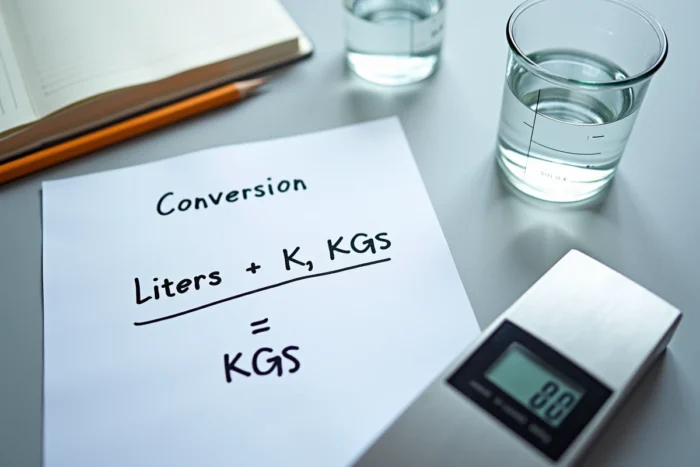
The formula remains the same:
- Mass (kg) = volume (L) x density (kg/L). This is the only formula to remember for converting volume to weight
- For pure water at 4 °C, the density is about 1 kg/L, hence the direct equality
- For a liquid denser than water (like honey or whole milk), a liter will weigh more than one kilogram
- For a less dense liquid (like oil), a liter will weigh less than one kilogram
Take sunflower oil, for example. Its density is around 0.92 kg/L. Therefore, a liter of oil weighs about 920 grams, not one kilogram. Pouring “one kilo of oil” by measuring a liter with a measuring cup introduces an error of nearly 80 grams.
Summary table of volume-mass conversion
| Liquid | Approximate density (kg/L) | Mass of 1 liter |
|---|---|---|
| Pure water (4 °C) | 1.00 | 1.00 kg |
| Whole milk | 1.03 | 1.03 kg |
| Vegetable oil | 0.92 | 0.92 kg |
| Honey | 1.42 | 1.42 kg |
This table shows that the conversion always depends on the liquid in question. Water is the only case where you can set liter = kilogram without calculation.
Milliliters, grams, and other units: adapting the formula
The relationship also works on a smaller scale. Since 1 liter contains 1,000 milliliters and one kilogram contains 1,000 grams, we can say that 1 milliliter of water weighs about 1 gram. This variation is very useful in cooking or pharmacy.
To convert from one unit to another without error, keep this logic in mind:
- First convert the volume to liters (for example, 500 mL = 0.5 L)
- Multiply by the density of the liquid in kg/L
- The result is directly in kilograms. Multiply by 1,000 if you want grams
A quick example: you need to weigh 250 mL of whole milk. Convert to liters (0.25 L), multiply by 1.03. You get about 0.258 kg, or 258 grams. Measuring “250 grams” instead of “250 mL” would have introduced a discrepancy of 8 grams.
Common mistakes in the liter-kilogram conversion
The first mistake, the most common, is applying the water equivalence to all liquid ingredients. In baking, confusing the weight and volume of oil or syrup skews the proportions of a recipe.
The second is forgetting that the container has weight. If you weigh a liter of water in a bottle without zeroing the scale, you measure the mass of the water plus that of the container. Zeroing the scale before pouring the liquid eliminates this bias.
The third concerns conversions between systems. An American gallon is not equal to an imperial gallon. Mixing these units with liters creates significant errors. The metric system has the advantage of directly linking the liter to the kilogram for water, which reduces the risk of confusion.
Remembering that the liter-kilogram conversion relies on the density of the liquid is enough to avoid mistakes. For water, the approximation 1 L = 1 kg remains reliable in the vast majority of practical situations. For any other liquid, a quick multiplication by the density gives an accurate result without needing an online converter.