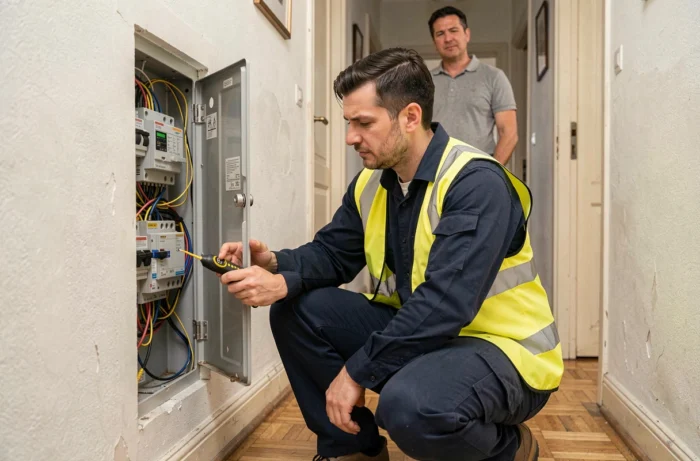
A power cut on a Sunday evening, a burning smell coming from the electrical panel, sparks at a socket: these situations leave no time to compare quotes. The natural reflex is to look for an electrician available immediately, but haste exposes you to two symmetrical risks: paying a rate disconnected from the market or entrusting your installation to an unqualified technician. The pricing and regulatory framework for emergency electrical repairs is poorly documented in usual search results, even though it directly affects the quality of the intervention.
Emergency electrician rates: what the 2026 grids reveal
The first useful reflex when faced with an emergency quote is not to negotiate, but to know if the announced amount corresponds to market practice. The grids published in 2026 for independent electricians place the standard hourly rate between €45 and €65 excluding tax in the provinces, and between €65 and €100 excluding tax in Paris and the inner suburbs.
Increases applied in the evening, on weekends, or on public holidays range from +30% to +100% depending on the time slot and geographical area. A repair billed at €180 excluding tax on a Saturday evening in Île-de-France can therefore remain consistent, while the same amount during the day in the provinces would indicate a clear overcharge.
About 16.3% of calls received by building craftsmen come in the evening, at night, or on weekends, according to a study covering 657 incoming calls. This volume explains why surcharges exist: they compensate for availability outside of regular hours. However, a professional who refuses to detail the calculation of their surcharge before intervention deserves particular scrutiny.
When a breakdown occurs outside of business hours, specialized platforms allow you to reach a professional available without waiting until Monday morning. The service Vite Un Électricien ! centralizes repair requests to direct you to craftsmen reachable during these off-hours.
Emergency electrician qualification: the checks that matter before opening the door
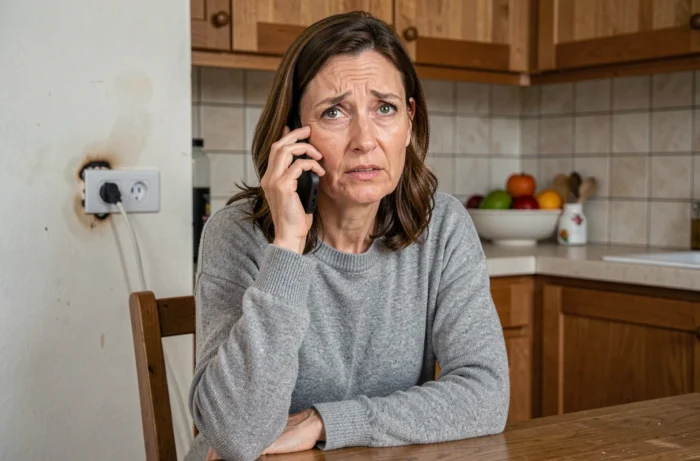
The pressure of the moment often pushes you to accept the first available technician. A few quick checks, doable in under two minutes, can help eliminate risky profiles.
- The mention Qualifelec or an equivalent certification attests to a skill evaluated by a third-party organization, not just declared by the craftsman themselves.
- A SIRET number verifiable on the INSEE website confirms the legal existence of the company and allows you to check that the declared activity corresponds to electricity.
- A valid professional liability insurance certificate covers any potential damages caused during the intervention.
- Knowledge of recent developments in the NF C 15-100 standard (series updated in 2024, applicable since 2025) distinguishes a professional who keeps up with regulatory news from a technician whose practices are outdated.
The new requirements of the NF C 15-100 series impose accessible emergency cut-off devices and enhanced differential protections. An electrician who works on a panel without mentioning these recent normative constraints does not offer the same guarantees as an up-to-date professional.
IRVE qualification: a signal of expanded competence
Since the IRVE qualification (Infrastructure for Electric Vehicle Charging) became mandatory for installing charging stations, electricians who hold it demonstrate an ability to train in demanding technical segments. This is not directly related to emergency repairs, but a qualified IRVE craftsman generally masters complex installations better than a technician limited to basic services.
Home electrical failure: technical actions before the electrician arrives
Between the call and the arrival of the professional, a few actions can reduce risk without requiring special skills. Cutting the main circuit breaker remains the first reflex if a burning smell or sparks are observed. Unplugging devices connected to the faulty circuit limits material damage in case of a surge when power is restored.
On the other hand, opening an electrical panel to manipulate internal components exposes you to the risk of electrocution. Any intervention inside the panel is exclusively the responsibility of a qualified professional. Even replacing a fuse can be dangerous if the fault originates from damaged wiring upstream.
Documenting the failure helps the electrician save time upon arrival. Noting the exact time of the cut, identifying the affected circuits (outlets only, lighting, entire home), and reporting any triggering event (connecting a device, storm) allows for a quicker diagnosis.
Electrical repair: distinguishing real emergencies from mere inconveniences
Not all failures justify an intervention billed with a surcharge. A burnt-out bulb, a switch that no longer responds, or a single non-working socket fall under a regular appointment during business hours.
Situations that require immediate repair share a common point: they present a risk to the safety of occupants or the integrity of the building. A circuit breaker that repeatedly trips, a panel that emits crackling sounds, a smell of melted plastic, or exposed wires are all in this category.
The distinction has a direct financial impact. An emergency call on a Sunday for a defective socket without immediate danger can cost double that of a scheduled intervention the following Tuesday. Taking thirty seconds to assess the actual severity of the problem before picking up the phone remains the most cost-effective decision in the face of an electrical failure.
The emergency electrical repair market still lacks transparency regarding pricing practices and actual intervention times. Field feedback varies on this point depending on geographical areas and the density of available craftsmen. Keeping in mind the published price ranges and systematically checking qualifications before opening your door remains, for now, the best protection available to individuals.