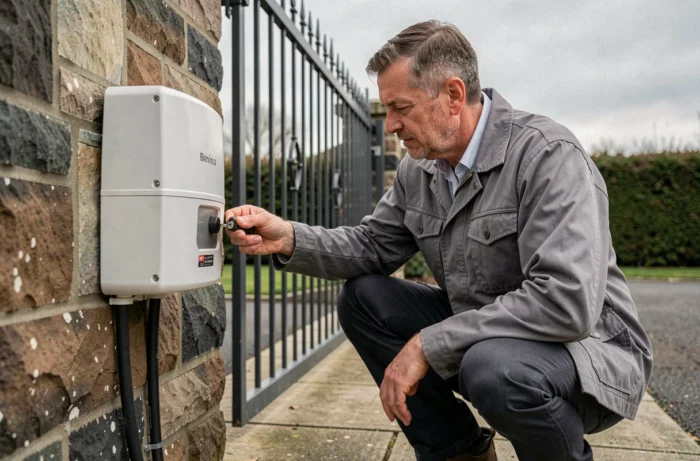
An electric Beninca gate that refuses to move after a power outage presents a real problem: getting in or out of your home. Beninca motors, particularly the Bull and PM series for swing gates, include a mechanical unlocking system with a key designed for this situation. Understanding how it works and anticipating the steps that follow the return of power prevents you from getting stuck or damaging the mechanism.
Beninca Mechanical Unlocking: The Principle to Know Before Acting
On Beninca motors for swing gates, unlocking does not go through an electric lock. The motor is released by a mechanical key inserted into a cylinder located directly on the body of the gear motor. This key disconnects the arm or the screw from the motor, allowing you to push the leaf by hand.
This mechanism works without any power supply. The key provided with the motorization kit is the only way to access this function. If you have lost it, you will need to contact a Beninca dealer to obtain a compatible duplicate for your model, as the cylinders vary by series.
Knowing how to open a Beninca gate in case of a power failure relies on this simple manipulation, provided you have the key at hand and follow a specific order to avoid forcing the internal components.
Manual Disengagement Procedure on a Beninca Swing or Sliding Gate
The manipulation differs slightly between a swing gate and a sliding gate, but the principle remains the same: release the motor to move the gate without mechanical resistance.
Beninca Swing Gate
- Locate the disengagement cylinder on each gear motor (one per leaf on a two-leaf gate). It is usually found on the top or side of the motor housing.
- Insert the key and turn it a quarter turn in the direction indicated by the manual (often counterclockwise). A click confirms that the motor is disengaged.
- Gently push the leaf by hand. If a mechanical central stop is installed, check that it does not block the movement before forcing.
- Once the gate is in the desired position, keep the disengagement active until power is restored. Only re-lock after power is back.
Beninca Sliding Gate
On a sliding gate, disengagement releases the drive pinion from the rack. The key is located on the motor, on the side opposite the rail. After disengagement, the gate slides on its rail without any particular effort, provided the rail is clean and not obstructed by debris.
Re-calibration After Power Restoration: The Step Many Forget
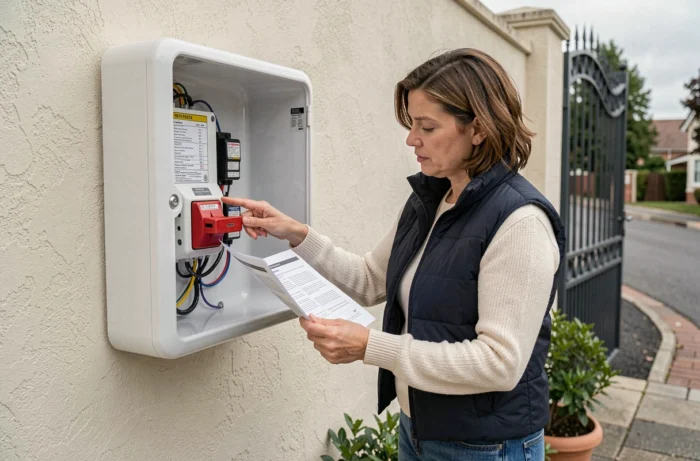
Restoring power does not always suffice to return to normal operation. This is a point that generic guides overlook, even though it constitutes the primary cause of blockage after a prolonged outage.
Beninca control units memorize the end-of-travel positions of the gate (open and closed). After a power failure or a storm, this memory can be disrupted. The gate then starts to operate erratically: it opens halfway, refuses to close, or reverses direction for no apparent reason.
Initiate the Self-Learning Procedure
Most Beninca control units (CP series, for example) have a self-learning mode for end-of-travel positions. The typical procedure involves cutting the power, re-locking the disengagement with the key, and then restoring power. The control unit automatically enters learning mode during the first command cycle.
During this cycle, the gate performs a complete opening and closing at reduced speed to recalibrate its electronic stops. This movement should not be interrupted. If the cycle is cut short (by an obstacle, a misaligned photocell, or a button press on the remote), the calibration fails, and the problem persists.
In case of repeated failure, check that the photocells and the STOP input are not at fault. On Beninca control units, a normally closed (N.C.) input that is not bridged can block the start of the cycle, even if the motor is powered. The control unit interprets this open input as a permanent stop order.
Preventive Solutions to Avoid Total Lockout
Waiting for the next outage to discover that the disengagement key is missing is not a viable strategy. A few simple measures can reduce the impact of a power failure on a Beninca gate.
- Keep the unlocking key in an accessible location from outside the property (a secure key box fixed to the wall, for example). A key stored in the garage behind a closed gate is useless.
- Install a compatible backup battery with your Beninca control unit. These backup batteries take over automatically and allow several opening and closing cycles without mains power.
- Test the manual disengagement once a year. A cylinder that hasn’t turned in several years may seize, rendering the key unusable at a critical moment.
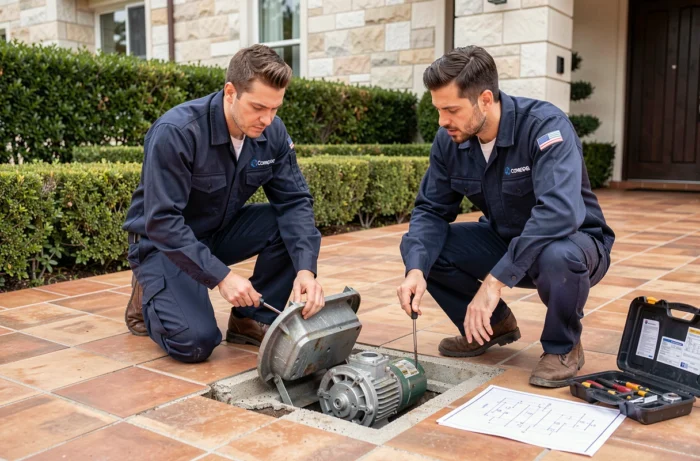
On installations exposed to frequent storms, a surge protector upstream of the control unit protects the electronics. A storm that damages the control board turns a simple outage into a failure requiring component replacement, with a longer intervention time and costs much higher than a backup battery.
The most useful reflex remains to know your installation before the failure. Identifying the location of the cylinder, checking that the key works, and knowing how to restart the calibration after a power cut covers the vast majority of situations where a Beninca gate remains stuck.