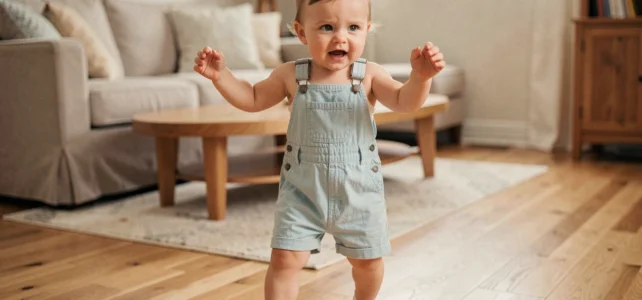
A baby’s first steps mark a motor transition whose consequences on home safety are measurable. Falls account for nearly 55% of accidents among those under 15 years old, and almost 49% of everyday accidents for 0-14 year-olds occur at home. Understanding which factors reduce this risk allows for supporting walking with concrete guidelines rather than generalities.
European Regulation and Childcare Product Safety
The legal framework surrounding equipment used during the learning to walk phase has recently changed. The Regulation (EU) 2023/988 on the general safety of products has been applicable since December 13, 2024. It imposes stricter regulations on childcare items (strollers, high chairs, cribs, baby carriers), along with associated harmonized European standards.
This regulation requires manufacturers and distributors to enhance traceability and report hazardous products. For parents, this means that any item sold in the European Union must now meet more stringent compliance criteria than before.
Before purchasing a walking trolley, a play gym, or a motor skills mat, checking for the CE marking and reference to a harmonized standard remains the most reliable action. The resources available on mespetitspas.fr also help identify equipment suitable for each stage of the child’s motor development.
Domestic Falls and First Steps: Data Guiding Prevention
Most articles on a baby’s first steps recommend clearing the space and installing corner protectors. These tips are correct but are rarely linked to the data that justifies them.
| Indicator | Data | Source |
|---|---|---|
| Share of falls in accidents among those under 15 | Nearly 55% | Public Health France / French Federation for the Prevention of Domestic Risks |
| Share of everyday accidents (0-14 years) occurring at home | Nearly 49% | Public Health France |
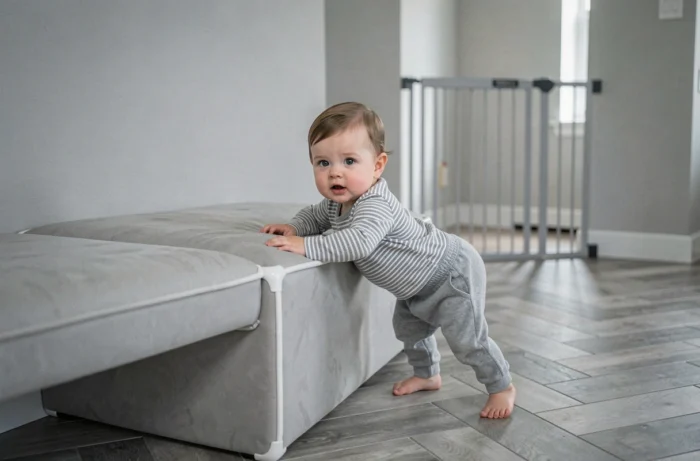
These two figures show that the home is the primary site of accidents for young children, and that falls are the dominant mechanism. A child starting to walk accumulates two risk factors: a high center of gravity (the head is proportionally heavy) and still unstable coordination.
In contrast, falls outdoors (parks, sidewalks) are less documented for this age group, confirming that the priority lies within the home.
Flooring and Shoe Choices: What Free Motor Skills Change
The current trend in pediatric development favors free motor skills, meaning allowing the child to explore motor stages at their own pace, without forcing standing or walking. This approach has direct implications for the environment.
- The floor should provide a stable and slightly non-slip surface. A waxed wooden floor or smooth tiles increases the risk of slipping. A thin mat securely fixed to the floor (no raised edges) strikes a balance between comfort and stability.
- Going barefoot remains the best option indoors. Bare feet capture sensory information from the ground and allow the child to adjust their balance. Non-slip socks are an alternative when the floor is cold.
- First shoes should only be used outdoors. They must be flexible, lightweight, with a thin sole that allows the foot to bend naturally. A rigid sole limits proprioception and can slow down learning.
The common belief that a high-top shoe “supports the ankle” is not supported by current child health recommendations. Support comes from gradual muscle strengthening, not a rigid counter.
Postural Support for the Baby: Hips or Raised Hands
The way an adult physically helps a child walk alters the posture the child adopts. Two approaches coexist, with different effects on balance.
| Type of Support | Effect on Posture | Limit |
|---|---|---|
| Hands held up | Arms raised, center of gravity shifted upwards, back arched | The child does not manage their own balance, dependence on support |
| Support at the hips (hands on hips) | Low support, trunk free, arms available for balancing | Requires the adult to bend down or squat |
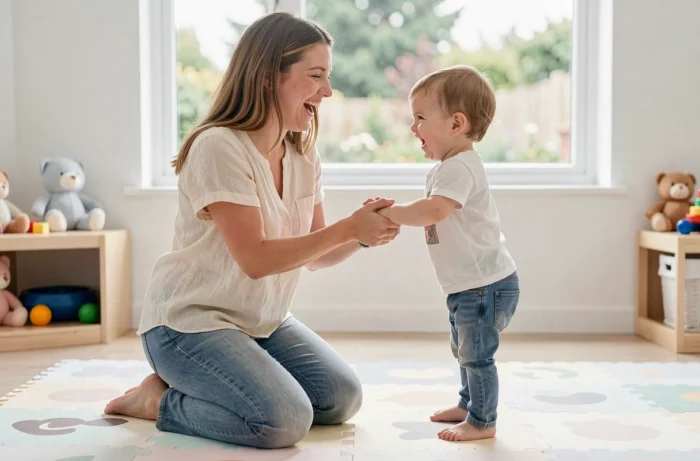
Supporting the hips rather than the hands allows the child to find their own point of support. When arms are held up, the baby shifts their weight onto the adult and does not learn to manage the forward-backward tilt. Hip support keeps the upper body free and replicates the conditions of autonomous walking.
This technique requires physical effort from the adult (squatting position), but it shortens the phase of dependence on external support.
Vigilance Signals and Pediatric Consultation
The age at which children acquire walking varies widely from one child to another, generally between 9 and 18 months. A child who is not walking by 14 months does not necessarily have a motor delay. However, certain signals warrant a consultation.
- The child cannot sit without support after 9 months.
- They show no attempt to pull themselves up by gripping furniture after 12 months.
- They exhibit marked asymmetry (always using the same side to propel themselves).
- Persistent stiffness or hypotonia of the lower limbs requires prompt medical advice.
Regular follow-up in child health consultations helps identify these discrepancies. The French health booklet includes motor milestones at each mandatory visit, providing a structured screening framework.
Autonomous walking establishes when muscle tone, coordination, and confidence converge. Adapting the home environment to actual risk data, choosing equipment compliant with current regulations, and respecting the child’s own pace remain the three most documented levers for reducing accidents related to first steps.