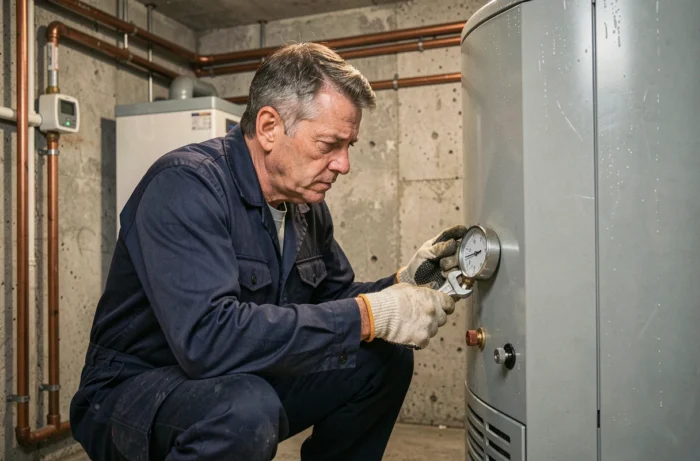
A vapor pressure that oscillates between two thresholds without clear stabilization rarely indicates a single problem. We observe in the field that pressure instability in boilers almost always results from a chain of minor failures that, taken in isolation, would go unnoticed during a standard inspection.
Worn safety valve: the silent failure mode
A safety valve that intermittently leaks continuously discharges water without leaving a visible trace on the ground. The flow is too low to form a puddle, but sufficient to drop the pressure by several tenths of a bar in a few hours.
This failure mode is distinct from classic micro-leaks on fittings or heat exchangers. The valve opens at a calibrated threshold, but wear on the seat or spring gradually lowers this threshold. The result: nuisance triggers at normal operating pressures, which the manometer does not always capture in real-time.
We recommend a simple test: place a container under the valve outlet during a complete heating phase. Any accumulation of water, even minimal, confirms an internal sealing defect that justifies replacement. Diagnosing boiler steam pressure instability issues often involves this check before any other intervention.
Expansion tank and pressure rise at heating startup
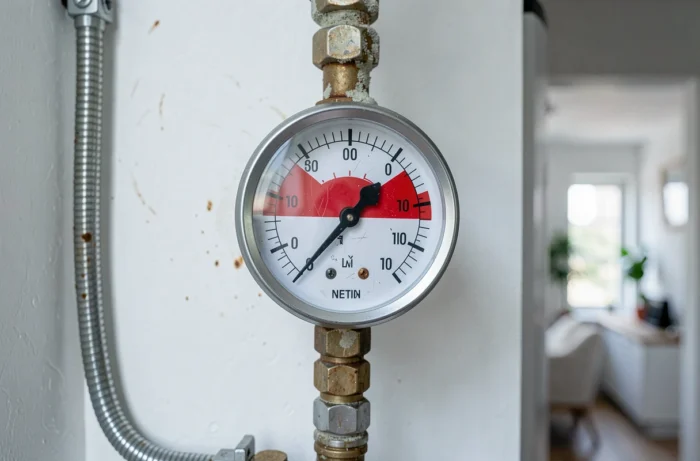
A rapid rise in pressure as soon as the burner ignites points to an expansion tank that no longer compensates for the water’s expansion in the circuit. The tank normally absorbs the volume increase related to the temperature rise. When its membrane is punctured or the nitrogen charge is insufficient, the circuit experiences overpressure as soon as the water heats up.
Two distinct mechanisms cause this loss of function:
- The inflation valve loses its seal, allowing nitrogen to escape gradually over several weeks. The pre-inflation pressure falls below the necessary threshold for compensation.
- The internal membrane tears, bringing the gas and water into direct contact. The tank fills with water and no longer acts as a buffer. A quick test involves pressing the valve: if water comes out, the tank is out of service.
- In older installations, the tank is sometimes undersized compared to the actual volume of the circuit (addition of radiators, expansion of the installation). The compensation volume becomes insufficient even with a functional tank.
Replacing or recharging the expansion tank is a common intervention, but it must be done with the circuit cold and pressure at zero to obtain a reliable measurement of the pre-charge.
Circulation pump and boiler pressure: an underestimated link
Consumer articles focus on leaks, radiator bleeding, and the expansion tank. The circulation pump is rarely mentioned as a factor of instability, even though it is in a significant proportion of cases.
A worn or partially blocked circulation pump alters the pressure distribution in the circuit. Insufficient flow creates areas of local overpressure upstream and depression downstream. The manometer, placed at a fixed point in the circuit, then displays variations that do not correspond to a water volume defect but to a hydraulic problem.
Distinctive signs of a failing pump
Noise is the first indicator. An irregular humming or periodic banging signals a seized rotor or a worn bearing. The pressure fluctuates in sync with these noises, allowing this cause to be distinguished from a tank or leak issue.
Checking the pump’s amperage while operating confirms the diagnosis. An overconsumption indicates an abnormal mechanical effort. On variable speed pumps, check that the controller regulates correctly: an electronic defect can cause flow surges that result in pressure oscillations.
Scaling and preventive monitoring of the heating circuit
In industrial steam installations as well as in residential boilers supplied with hard water, scaling of the tubes reduces the passage section and disrupts thermal exchanges. The direct consequence is a slower temperature rise and pressure variations related to irregular heat transfer.
The conductivity and hardness of the feed water serve as early warning signals. Water with hardness exceeding the manufacturer’s recommended threshold accelerates fouling. In a closed circuit, this hardness should remain stable after the initial filling. If it increases, it indicates frequent water top-ups, an indirect sign of a leak or valve problem.
Control points to integrate into annual maintenance
- Measure the hardness of the circuit water and compare it to the initial filling value. Any significant deviation reveals undetected top-ups.
- Check the pre-charge of the expansion tank when cold, before any pressurization of the circuit.
- Inspect the safety valve outlet for signs of limescale or residual moisture.
- Check the amperage of the circulation pump and compare it to the nominal value indicated on the nameplate.
These four checks take a few minutes and cover the causes of pressure instability that standard maintenance (burner cleaning, flue gas check) does not detect. A heating technician who systematically integrates them reduces the risk of unexpected safety shutdowns and extends the lifespan of the installation.
Pressure instability is not a symptom to be treated superficially. Each oscillation of the manometer tells a precise hydraulic or mechanical story. Identifying the root cause avoids the classic cycle of repeated water refills that masks the problem without solving it.