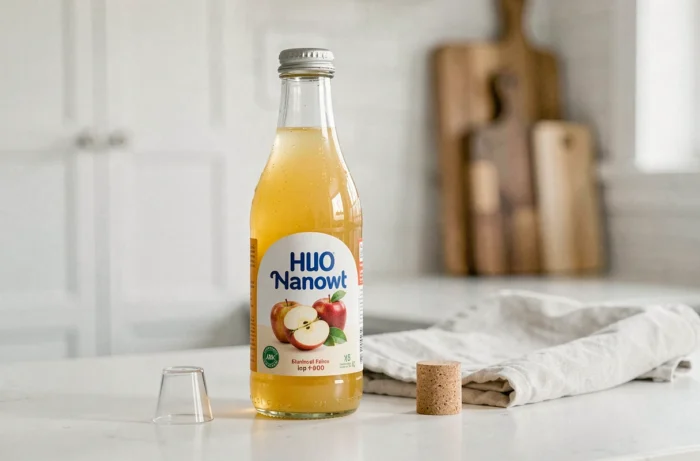
Champomy is a carbonated drink made from apple juice, non-alcoholic, packaged under CO₂ pressure. Its composition and bottle format (metal cap, glass, or PET depending on the reference) impose storage constraints similar to those of sparkling ciders, not champagne. Confusing the two leads to handling errors that accelerate degassing and alter the taste.
Residual pressure and degassing of Champomy after opening
A closed bottle of Champomy maintains its dissolved CO₂ due to internal pressure. As soon as the cap is removed, this pressure drops sharply. The carbonated apple juice loses its bubbles much faster than a sparkling wine because the absence of alcohol accelerates the release of carbon dioxide.
Temperature plays a direct role in this kinetics. A cold liquid retains dissolved CO₂ better than a lukewarm liquid. Leaving the bottle open on a snack table at room temperature, even for ten minutes, is enough to significantly reduce the fizz perceived by children at the second serving.
We recommend recapping the bottle immediately after each serving, without waiting for the end of the snack. Every second of exposure to open air counts. To store Champomy for children from one day to the next, quick recapping is the only truly decisive variable.
Opened Champomy: which stopper to use for the next day
The original cap cannot be replaced. This is the main problem. Unlike a champagne cork that can be reinserted, the metal cap of Champomy is destroyed upon opening. Therefore, a replacement device is needed.
Lever stopper
Stopper devices designed for sparkling wines (type “gardbulles”) work on Champomy. They create a mechanical seal with a silicone gasket that limits the escape of CO₂. A lever stopper keeps the fizz for 24 to 48 hours in the refrigerator, which exactly corresponds to the scenario “snack today, serve again tomorrow”.
Plastic wrap and rubber band
This makeshift method is worthless. The cling film cannot withstand the residual gas pressure and deforms within a few hours. We regularly observe “recapped” bottles that arrive flat by the next morning. To be avoided.
Reused cork
Inserting a wine cork into the neck of the Champomy may seem logical, but the diameter does not always match. If the cork is not perfectly fitted, the seal will be insufficient. This solution only works if the cork fits the neck without any play.
Storage temperature for opened Champomy in the refrigerator
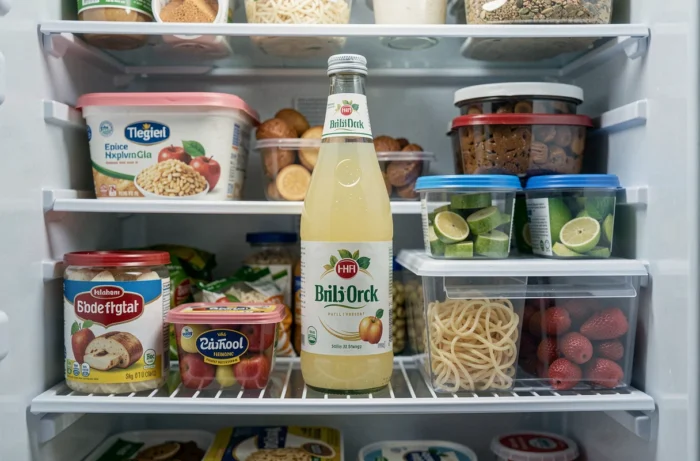
The domestic refrigerator typically operates between 3 and 6 °C. This is the ideal range to slow down the degassing of an opened carbonated drink. Place the bottle upright, never on its side, to reduce the surface area of contact between the liquid and the air trapped in the neck.
A often overlooked point: compressor vibrations. On some older refrigerators, the motor transmits micro-vibrations to the shelves. These regular jolts promote the nucleation of CO₂ (bubble formation on the surface of the liquid), which accelerates degassing even when the bottle is closed. Placing the Champomy on the shelf farthest from the compressor, usually at the top, limits this phenomenon.
The refrigerator door, although convenient, is the worst location. It experiences temperature fluctuations with each opening and repeated mechanical shocks. The bottom of a high shelf remains the optimal location for a Champomy that you want to serve again the next day.

Opened Champomy: when to throw it away instead of serving it again
Champomy is a pasteurized fruit juice, not a sterile product once opened. After opening, microorganisms can develop, especially if children have drunk directly from the neck or if the bottle has been left out of the cold for a long time.
Here are the signals that should trigger disposal:
- A sour or fermented smell that was not present at initial opening, indicating spontaneous fermentation of residual sugar
- A distinctly altered taste, vinegary or with unusual bitterness, even if the bubbles are still present
- A cloudy appearance or the presence of suspended filaments, indicating microbial development
- A bottle left out of the refrigerator for more than two hours after opening, even if recapped
Beyond 48 hours in the refrigerator, we advise against serving Champomy, even if the drink still seems fizzy. The taste deteriorates and the health risk, although low, is not negligible for young children.
Serving stored Champomy without disappointing children
A Champomy that has spent a night in the refrigerator with a good stopper retains some of its effervescence, but the fizz will be less lively than at opening. Children, especially younger ones, perceive this difference and may refuse the drink.
A simple technique: serve in narrow glasses rather than wide cups. A narrow-walled glass limits the surface area of exchange with the air and concentrates the remaining bubbles, giving a more sparkling sensation in the mouth. Plastic champagne flutes sold for children’s parties serve this purpose perfectly.
Pouring slowly, tilting the glass, also preserves more CO₂ than pouring straight into the bottom of the cup. It’s the same principle as for beer: the less turbulence created, the less gas is released.
If the bottle is really too flat despite these precautions, the remaining Champomy can serve as a base for a non-alcoholic fruit cocktail. Mixed with fresh fruit pieces in a pitcher, it advantageously replaces a classic juice at snack time, and the children no longer notice the absence of bubbles.