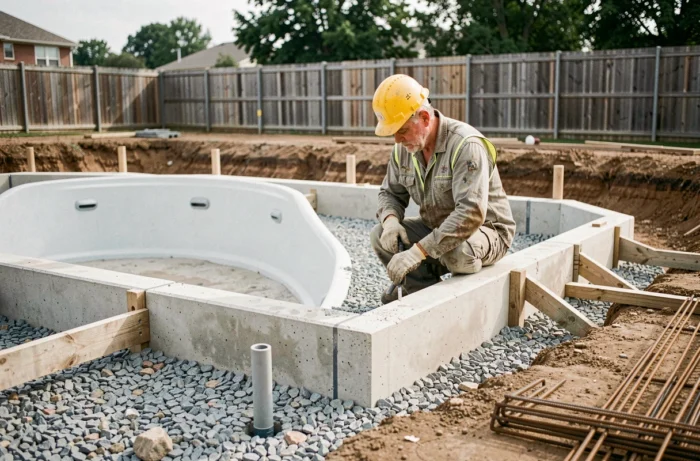
On a filled or slightly sloped ground, the concrete belt of a shell pool is not just a decorative frame for laying coping stones. There have been sites where the belt, sized as if on stable ground, cracks after the first winter because the fill has settled unevenly. Understanding the dimensions of the concrete belt for shell pools requires distinguishing between two logics: the peripheral finish and structural reinforcement.
Finishing belt or structural belt: two roles, two dimensioning
The confusion arises from the fact that most guides treat the concrete belt as a single structure. In practice, two very different situations are encountered on site.
When the ground is load-bearing, compact, and homogeneous, the belt primarily serves as support for the coping stones and as a transition between the edge of the shell and the deck. In this case, modest widths and thicknesses are sufficient to distribute the weight of the coping slabs without creating a hard point on the shell.
In contrast, on filled, clayey, or sloped ground, the belt becomes a true peripheral structure. It must stabilize the top of the basin and withstand the lateral pressures from the soil. The reinforcement, anchoring depth, and section change radically. Treating these two cases with the same dimensions amounts to under-sizing one or over-sizing the other.
Before finalizing dimensions, time is saved by analyzing the nature of the soil. A site that has been filled less than three years ago, for example, has not finished settling. The belt will then need to compensate for movements that the fill has not yet produced.
To better understand the dimensions of the concrete belt for shell pools and the steps for implementation, it is essential to first identify these soil constraints before discussing formwork.
Width and thickness of the concrete belt according to the ground
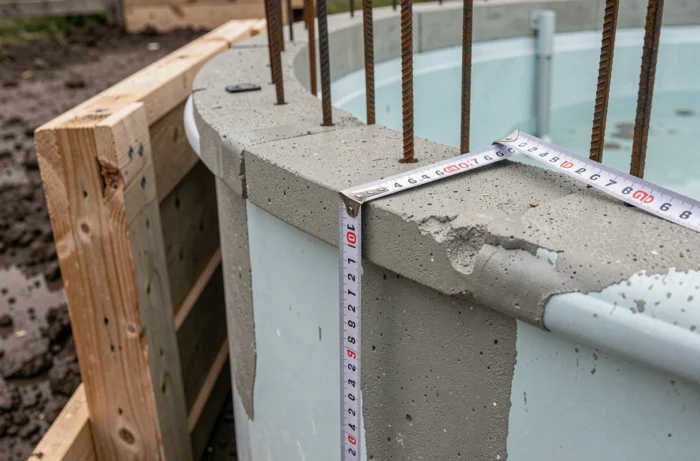
Opinions vary on this point, but a technical consensus emerges around a few concrete benchmarks.
Stable and compact ground
On unaltered natural ground, the belt fulfills its role as support for coping stones with a width between the width of the coping plus a few centimeters of overhang on the pool side. The thickness remains moderate, suitable for the weight of the coping stones and pedestrian traffic along the pool edge.
Filled or clayey ground
As soon as the soil has been brought in or swells with water, the section is widened and thickened. The reinforcement changes from a simple welded mesh to a HA steel framework with regular frames, especially in the corners and around the sealing elements (skimmers, returns). The belt must extend deeper to find support on the existing ground, not on the fill.
Sloped shell pool
On sloped ground, one side of the basin ends up with more fill than the other. The belt cannot have the same section all around: the downstream side, more exposed to soil pressures, requires localized reinforcement. Some installers pour a deeper beam on the downstream side, connected to the peripheral belt.
Heavy natural stone coping: impact on dimensioning
The choice of coping directly influences the section of the belt. A lightweight reconstituted stone coping does not stress the concrete the same way a thick natural stone coping does.
- Natural stone coping (travertine, granite, sandstone) weighs significantly more per linear meter than a molded concrete cap. The belt must absorb this extra weight without bending or creating a cantilever on the edge of the shell.
- An excessive overhang of coping above the water, without sufficient support on the belt side, generates a lever effect that can detach the coping over time due to freeze-thaw cycles.
- The width of the belt must cover at least the entire base of the coping, with an additional overhang on the earth side to anchor the concrete into the load-bearing soil.
Adapting the width of the belt to the coping prevents detachment after a few seasons. It is common to encounter natural stone coping that shifts because the belt was designed for a standard cap.
Reinforcement and reinforced concrete: what changes between finish and structure
The reinforcement makes the difference between a belt that holds and one that cracks. On stable ground, a welded mesh placed at mid-thickness is sufficient to handle the shrinkage stresses of the concrete and the weight of the coping stones.
On difficult terrain, we switch to HA steels in lower and upper layers, with regularly spaced vertical frames. The corners of the basin concentrate the stresses: this is where cracks appear first if the reinforcement is not continuous. The continuity of the reinforcement in the corners determines the integrity of the whole.
The concrete itself must be mixed sufficiently to ensure good compressive and tensile strength. A mix that is too lean disintegrates on the surface after a few winters, especially in regions where frost is common. The cover of the steels (the distance between the reinforcement and the surface of the concrete) must remain sufficient to protect the reinforcement from corrosion.
Peripheral drainage and interaction with the concrete belt of the shell pool
One point that most articles on dimensions overlook: without proper drainage, even a well-sized belt will eventually fail. Water that stagnates around the basin creates hydrostatic pressure on the shell and softens the supporting soil of the belt.
A peripheral drain placed at the bottom of the excavation, below the level of the belt, evacuates runoff water and limits variations in soil bearing capacity. On clayey soils, this drain is not optional. Without it, the clay swells in winter and shrinks in summer, causing the belt to move cyclically.
The drain connects to a discharge point (stormwater network, sump) and is protected with a geotextile to prevent clogging. This step is carried out before pouring the belt, not after.
The concrete belt of a shell pool does not have a universal dimension. The soil, slope, weight of the coping stones, and the presence or absence of drainage modify each parameter. Fixing dimensions without knowing the ground is like building blindly. A soil diagnosis before the project remains the best investment to avoid costly repairs two or three years later.