
The beige suit presents a problem that navy blue or charcoal gray never did: its undertone. Depending on whether it leans towards cool sand, golden camel, or greenish ecru, the tie that works changes radically. We recommend determining this undertone even before considering a tie color, lest you create a dull or discordant ensemble.
Beige Undertone and Its Impact on Tie Choice
A cool sand beige (pale gray-yellow) absorbs light differently than a warm camel beige (ochre-brown). On the former, a burgundy or navy tie creates a sharp contrast without harshness. On the latter, these same shades appear dull, almost muted.
Identifying the undertone is done by placing the suit against pure white fabric. If the beige seems to yellow by contrast, the undertone is cool. If it appears to pink or golden, the undertone is warm. This simple test guides everything else.
For warm beiges (camel, light caramel), we observe that ties in the terracotta, rust, or olive green range integrate with a coherence that royal blue does not achieve. The question of which tie to match with a beige suit therefore depends first on this tonal analysis, not on a theoretical color match applied indiscriminately.
For cool beiges (sand, greige, stone), the spectrum opens up to deep navy, burgundy, and plum purple. These saturated shades highlight the cool brightness of the fabric without entering into chromatic conflict.

Tie Material with a Beige Suit: Shiny Silk or Matte Texture
Consumer articles almost systematically recommend silk. On a beige suit, very shiny silk creates a mismatch that detracts from the overall look. The beige suit, especially in linen, cotton, or summer blend, belongs to a casual or semi-formal register. A satin silk tie pulls it towards a formality that the suit’s color contradicts.
A linen-silk blend or matte silk grenadine offers a textured surface that dialogues with the grain of the beige fabric. La Cuillère d’Argent notes that a linen-silk blend with a beige suit avoids the artificial contrast of a tie that is too smooth. We share this observation.
Preferred Materials by Season
- Linen or linen-silk tie: dry texture, natural look, ideal from spring to summer. The knot will be slightly irregular, which reinforces the coherence with the casual character of beige.
- Silk grenadine: airy weave with a matte surface, works across three seasons. Its subtle relief captures light without a mirror effect.
- Fine wool or light cashmere: reserved for autumn-winter. The matte touch and density of wool match well with flannel or gabardine beige.
- Cotton: very matte finish, suitable for the most casual contexts. Cotton wrinkles quickly, limiting its use to consciously casual outfits.
Classic silk with a shiny finish remains relevant only if the beige suit is made from a smooth fabric (fine gabardine, worsted wool), worn in a strictly formal context.
Tie Width and Lapel Proportions on a Beige Suit
The width of the tie should match that of the suit’s lapel, within a centimeter. This rule applies to all suits, but it takes on increased importance with beige. A light suit exposes proportions more: a width discrepancy between lapel and tie is immediately noticeable on a beige surface.
Current beige suits often adopt a medium-width lapel. We recommend a tie in the same range. A slim tie on a wide lapel creates a cramped effect that the lightness of the fabric amplifies.
The Right Knot for Beige
The four-in-hand (simple knot) produces an asymmetrical and slightly relaxed knot that suits the register of the beige suit. The Windsor knot, bulkier and symmetrical, works on a beige gabardine suit worn with a cutaway collar shirt, but it stiffens the silhouette.
On a linen beige suit, a Windsor knot is almost always a mistake. The natural crumple of linen calls for a relaxed knot. The half-Windsor is an acceptable compromise when the shirt collar requires a bit more volume.
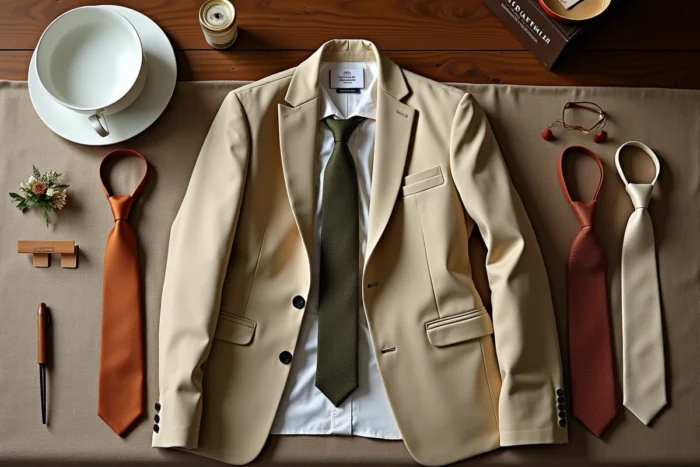
Tie Colors by Context: Formal, Wedding, No Tie
The beige suit blurs the lines of the classic dress code. In a semi-formal professional context, a navy grenadine tie remains the safest choice: it adds seriousness without overpowering the beige. Dark burgundy produces a comparable effect, with a warmer touch.
For a wedding, the beige suit offers a broader chromatic latitude. Old rose, terracotta, or sage green ties work particularly well, especially on warm beiges. Striped ties remain possible, but we limit them to tone-on-tone stripes (beige and cream) or discreet two-color combinations (navy and white).
The trend of wearing a beige suit without a tie is normalizing. Connectthedots-prepa.fr notes that in 2026, the suit without a tie is accepted at oral exams for prestigious schools, provided the outfit remains coherent. Blandin & Delloye even offers a beige linen wedding suit designed to be worn with an open shirt. The choice not to wear a tie with a beige suit is now a legitimate style option, not a lack of effort.
When a tie is present, bright red or yellow are the two colors that pose the most problems on beige. Bright red creates too violent a contrast that draws the eye exclusively to the neck. Yellow, even when bold, blends into the beige and eliminates any visual relief.
The choice of a tie for a beige suit relies on three technical parameters in this order: the undertone of the fabric, the material of the tie, and then the color. Reversing this hierarchy produces the flat associations we see too often. A camel beige with a rust grenadine or a sand beige with a navy linen-silk tie withstands most contexts, from the office to a wedding.