Graphic design attracts high school students from very different backgrounds each year. General baccalaureate with a specialty in history-geography, STI2D baccalaureate, STMG baccalaureate: none of these paths closes the door to post-baccalaureate training in graphic design. The French admission framework allows real latitude for candidates, provided they understand how each access route works and what it expects.
Admission outside Parcoursup: an unknown option for general and technological baccalaureates
Parcoursup centralizes access to DN MADE, BTS, and preparatory courses in applied arts. But another route exists and is developing: specialized schools that recruit directly, without going through the national platform.
Schools like G.Art, focused on video game-oriented graphic design and digital creation, accept applications from any general or technological baccalaureate holder. Selection is based on a personal portfolio and an interview of about one hour, centered on the candidate’s professional project and skills, not on their original field.
For these institutions, a general baccalaureate with a specialty in plastic arts or digital and computer sciences is considered relevant, just as a technological baccalaureate STD2A is. However, a baccalaureate with no direct link to the arts is still acceptable. The discriminating criterion is not the transcript of grades, but the ability to demonstrate a personal creative approach, even in its early stages.
This route outside Parcoursup offers a concrete advantage: response times are often shorter, and the candidate is not subject to the rigid schedule of admission phases. The trade-off is financial, as these private schools have tuition fees that are significantly higher than public training programs.
Before committing, it is worth checking if the institution is recognized by the state and if the diploma awarded is registered with the RNCP.
Those considering joining a graphic design school after the baccalaureate benefit from systematically comparing the Parcoursup routes and direct admissions, weighing cost, diploma recognition, and actual educational content.
DN MADE graphic design: what the diploma really requires from a non-artistic baccalaureate
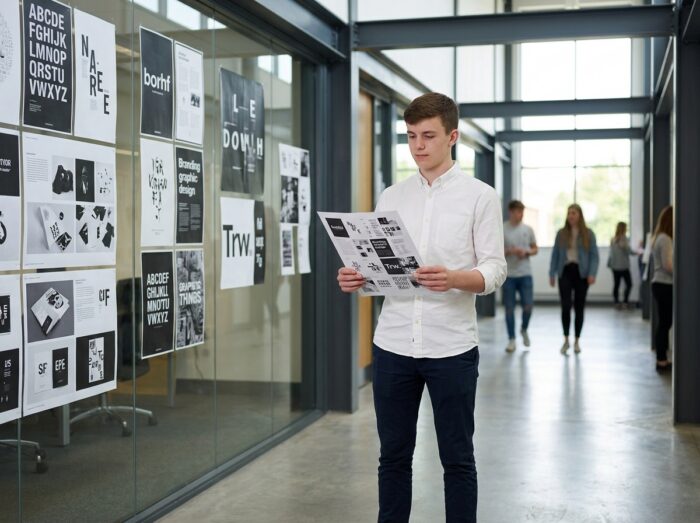
The DN MADE graphic design program remains the public reference training for entering graphic design at bac+3. It confers a bachelor’s degree and structures its teachings around three poles: culture and humanities, transversal teachings (digital tools, materials, modern languages, economics-management), and practical creation workshops.
No specific baccalaureate specialty is formally required to apply. Admission committees evaluate the overall academic record, the motivation letter, and often a portfolio or visual research notebook. A student from a general baccalaureate without a plastic arts option is not automatically eliminated, but they must compensate with personal works that demonstrate their graphic curiosity.
The challenge arises after admission. The first weeks of the DN MADE confront students from non-artistic backgrounds with drawing, typographic composition, and mock-up exercises they have never practiced. Feedback from the field varies on this point: some teachers believe that uninitiated profiles catch up on their technical skills within a few months thanks to intensive workshops, while others observe a higher dropout rate in the first year among these same profiles.
What makes a difference in the application file
The formal criteria are public, but their weighting varies from one institution to another. Three elements consistently appear in jury feedback:
- A personal portfolio, even modest, that shows regular practice (sketches, photographs, layouts, digital projects). Quantity matters less than the coherence of the approach.
- A motivation letter that names specific designers, studios, or graphic projects, rather than generic phrases about a passion for creativity.
- Acceptable results in French and philosophy, which attest to a capacity for analysis and writing applied in design culture courses.
Grande école pathway in design over five years: a recent post-baccalaureate option
The Condé school announced for the 2026 academic year a grande école pathway in design accessible from the baccalaureate, over five years, with progressive specialization and international exposure. This long format, modeled after business or engineering schools, is new in the field of French graphic design.
The interest for a general or technological baccalaureate holder is twofold. First, specialization occurs during the course, not at entry: a student who is undecided between graphic design, motion design, and art direction does not have to make a choice in their final year. Second, the targeted diploma is a bac+5, which positions the graduate differently in the job market compared to a DN MADE (bac+3) or BTS (bac+2) holder.
The available data does not yet allow for measuring the actual selectivity of this new pathway or its professional insertion rate, as the first cohort has not yet graduated. It will be necessary to observe the first cohorts to see if the model lives up to its promises.

Building a strong application without an artistic background in high school
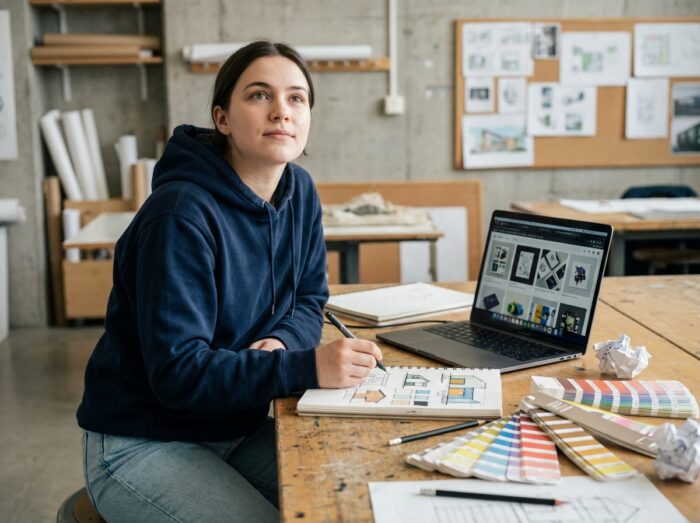
The real barrier for a student in a general or technological non-artistic baccalaureate is not eligibility: it is the ability to prove credible graphic motivation without having followed dedicated training. Here are some concrete suggestions:
- Take online courses in typography or visual composition on open platforms, and document exercises in a digital notebook.
- Participate in high school graphic competitions or in associative projects requiring the creation of posters, logos, or communication materials.
- Visit design exhibitions (Biennale de Saint-Étienne, exhibitions at the Centre Pompidou, graphic arts festivals) and write short analyses that can be included in the application file.
- Request an observation internship in a graphic design studio or with a freelancer, even for a week. A professional internship weighs more than an optional subject in an application file.
None of these steps replaces a three-year plastic arts specialty. However, they demonstrate an active curiosity, which the DN MADE juries and private schools know how to recognize. Personal work outside of high school counts as much, if not more, than the academic path in the final evaluation of an application file.