
Underground parking, end of the day: we press the remote, nothing happens. The four doors remain locked (or unlocked), and the usual click of the lock motor is gone. Before thinking of a key battery issue or a complex electronic fault, the quickest reflex is to check a component that costs less than a euro: the central locking fuse.
Why the central locking fuse blows
The fuse protects the central locking circuit from overcurrents. Its filament intentionally melts to cut off the current before a short circuit damages the lock motor, control unit, or door wiring.
In practice, we encounter two common scenarios. The first: a door wire worn from repeated openings and closings comes into contact with the metal. The second: water seeps into a connector at the bottom of the door and creates an electrical bridge. In both cases, the fuse melts to prevent more serious damage, and the central locking stops working suddenly.
To understand the car central locking fuse on Carfully, it is important to note that this component acts as a voluntary sacrifice of the circuit, not as a typical wear part. If the fuse blows once, it is often benign. If it blows again after replacement, the problem lies elsewhere.
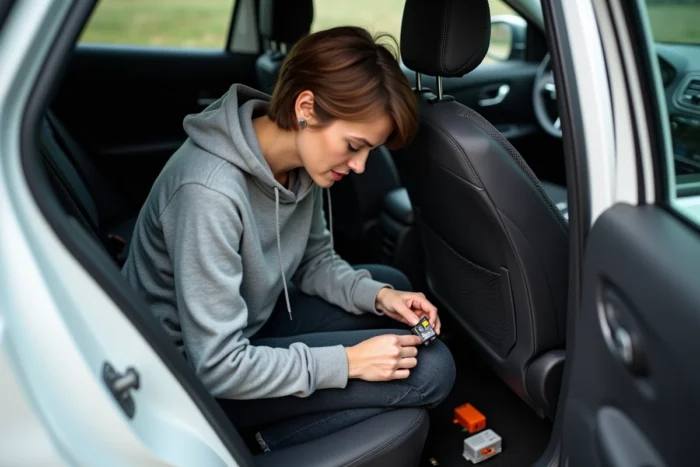
Locate the fuse box according to your vehicle
The difficulty is not in changing the fuse, but in finding it. Depending on the manufacturers, the fuse box can be located in three different places:
- Under the dashboard on the driver’s side, sometimes protected by a clipped plastic cover that can be removed by hand.
- In the engine compartment, near the battery, in a waterproof box with a lever cover.
- Less commonly, in the trunk or under the rear bench (some Volkswagen or BMW models).
The owner’s manual remains the most reliable reference for identifying the exact location. On the cover of the box, a printed diagram assigns a number and amperage to each fuse. Look for the mention “central locking,” “locking,” “ZV” (Zentralverriegelung on Volkswagens), or “door lock.”
When the diagram is unreadable or missing
On a used vehicle, the cover may sometimes be missing or the text has faded. In this case, you can search for the exact reference of the fuse-relay box (often abbreviated BFR) in the online technical documentation for your model. Forums dedicated to a specific brand usually indicate the position of the fuse, its location number, and its rating.
Check a central locking fuse with a multimeter
A fuse may appear intact to the naked eye while being blown. The internal filament is sometimes so thin that a break remains invisible through the colored plastic. A continuity test with a multimeter eliminates any doubt in seconds.
Set the multimeter to continuity mode (diode symbol or buzzer). Place the two probes on the two metal legs of the fuse. If the multimeter beeps, the fuse conducts: it is good. No beep, no continuity: it is blown.
This check takes less than a minute and avoids replacing a functional fuse, which would delay the search for the real fault (connectivity, ground, faulty lock motor).
Common trap: confusing fuse and relay
In the same box, there is often a central locking relay, a small plastic cube that can be confused with a high-capacity fuse. The relay switches power to the lock motors. If you hear a click in the box when you press the remote but the doors do not move, the relay or the lock motor is the issue, not the fuse.
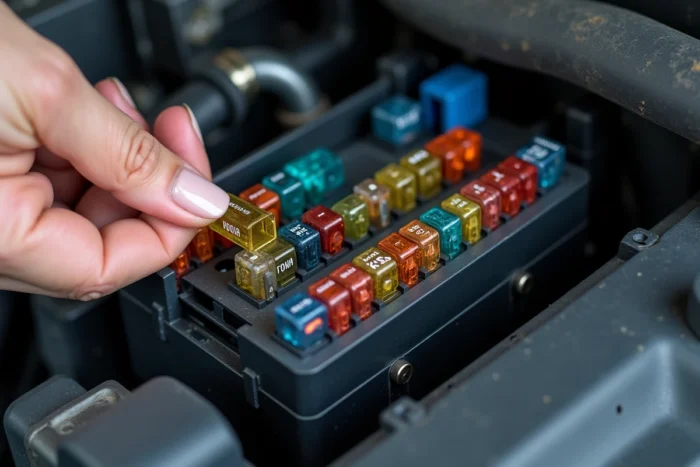
Replace the central locking fuse step by step
Ignition off, key removed. Never work on a fuse box with the ignition on, even in accessory position.
- Remove the suspect fuse with the plastic pliers provided in the cover of the box (or with needle-nose pliers if they have been lost).
- Check the amperage written on the removed fuse. Replace it strictly with a fuse of the same amperage. A higher rating would allow an overcurrent to pass without protecting the circuit.
- Insert the new fuse into the same slot, straight, until you feel a slight click of retention.
- Turn the ignition back on and test the remote. The four doors should respond simultaneously.
If the central locking works again, the problem is resolved. If the new fuse blows immediately or in the following days, the short circuit persists somewhere in the circuit. The most common causes are a ground issue, oxidized connectivity in a door, or a stuck lock motor that draws too much current.
When the fuse is not the cause
Field reports show that the central locking failure does not always come from the fuse. On some vehicles, the central locking control unit itself fails, and specialized forums sometimes describe a complete replacement of the BFR as the only solution. If the fuse is intact and the relay clicks normally, the diagnosis should go back to the control unit or the door wiring.
Reports vary on this point depending on models and generations of vehicles, but one rule remains constant: always start with the simplest (fuse, then relay, then connectivity) before considering replacing an electronic module.
A central locking fuse that blows once after several years of service does not indicate a serious defect. A fuse that blows repeatedly indicates an active short circuit that needs to be traced wire by wire, ideally with an electrical diagram of the vehicle in hand. Without this methodical diagnosis, there is a risk of replacing expensive parts unnecessarily.