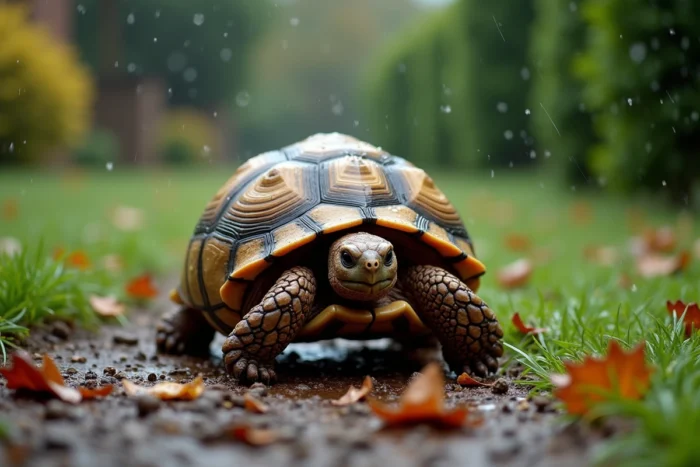
A Hermann’s tortoise coming out of its shelter during a June downpour, shiny shell, drinking the droplets running down its beak. We observe it from the window, ready to intervene. Most of the time, we are wrong to worry.
Land Tortoise and Rain: A Hydration Reflex, Not Distress
On specialized forums, the scenario repeats every spring: you find your tortoise outside in the rain, you panic, and you bring it inside the house. This reaction comes from good intentions, but it ignores a well-documented natural behavior.
Land tortoises, with Hermann at the forefront, actively use rain to hydrate themselves. They lower their heads, absorb the water running down their shells, and take advantage of the ambient humidity to rehydrate their bodies. The Valley of Tortoises, a specialized park in the Pyrénées-Orientales, reminds us that tortoises love rain in summer because it allows them to drink and cool off. Kélonia, an observation center in La Réunion, describes these episodes as true “rain baths.”
When observing land tortoises in the rain, we often find that they are more active than usual: they move around, explore, and drink. This is not a sign of panic; it is an adaptive behavior shaped by millennia of evolution.
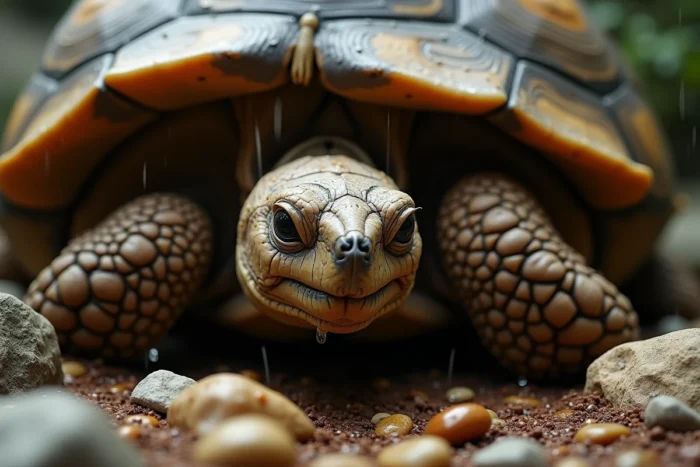
Prolonged Rain and Saturated Soil: The Real Danger for a Tortoise in a Pen
Occasional rain is not a problem. What changes the game is the duration and intensity. A waterlogged ground for several days becomes a real risk for a land tortoise kept in a pen.
Risks Associated with Standing Moisture
When the substrate remains soaked, the tortoise can no longer warm itself properly on the ground. Constant humidity promotes the development of fungi on the skin and shell. Field reports from many breeders also indicate an increased risk of rhinitis, a common respiratory infection in Hermann’s tortoises kept in an environment that is too humid and cold.
Runoff water also degrades the enclosure: it displaces substrates, creates muddy areas where the tortoise can get stuck, and sometimes carries debris that obstructs resting areas. The problem is not the rain falling on the shell; it is what happens on the ground afterward.
The Trap of Sudden Temperature Changes
A common reflex is to bring the tortoise inside the house as soon as it rains heavily. Experienced breeders strongly advise against this. A quick transition from outside to a heated interior causes thermal shock that is far more dangerous than a downpour. If intervention is necessary, the tortoise should be moved to a dry shelter within the enclosure, not into the living room.
Designing an Enclosure that Gives the Tortoise a Choice
The question is not to protect a tortoise from rain, but to offer it the opportunity to protect itself. A well-designed enclosure makes human intervention almost unnecessary.
The goal is to create several microclimates within the same space. The tortoise then chooses its area based on the weather, temperature, and its current needs. We do not decide for it.
- A covered shelter with dry hay, slightly elevated from the ground to prevent water from pooling, serves as the main refuge against prolonged downpours.
- A compacted earth area or draining substrate (a mix of soil and sand) allows water to infiltrate quickly instead of creating persistent puddles.
- A cold greenhouse or a glass frame provides a warm spot even in overcast weather, without relying on a permanent UVB lamp.
- Upside-down tiles or pieces of bark placed in various locations create additional micro-shelters that the tortoise spontaneously uses.
An enclosure with only one shelter forces the tortoise to choose between everything or nothing: either it stays outside in the rain, or it confines itself to a single space. Increasing options respects its natural thermoregulation behavior.
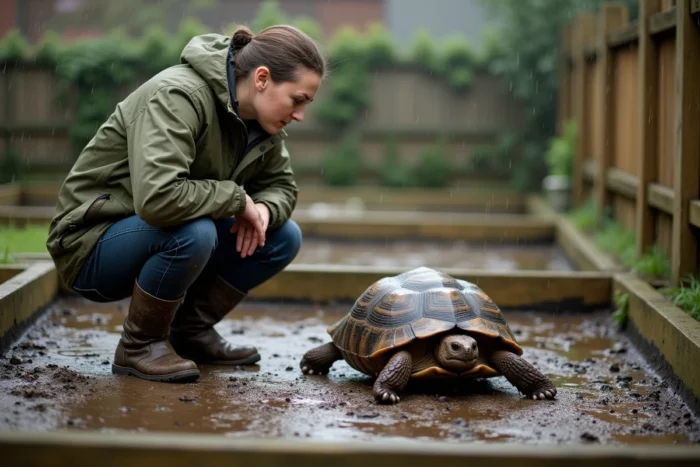
Extreme Weather Events: Adapting Breeding Practices in the Garden
Episodes of heavy rain are becoming more frequent in our latitudes. For outdoor land tortoise keepers, this changes management habits, especially in spring and autumn when temperatures drop quickly after a downpour.
After a heavy rain episode, we inspect the enclosure before allowing the tortoise to roam freely. We check three things: the state of drainage (no persistent puddles), the integrity of shelters (dry hay, no mold), and the absence of debris carried by runoff.
A tortoise that remains lethargic after the rain deserves special attention. If it does not resume activity when the sun returns, if its nose is running, or if its breathing produces a wheezing sound, a consultation with a veterinarian specialized in reptiles is necessary. Reports vary on this point, but caution is warranted as soon as any respiratory sign appears.
Special Case: Juveniles and Hibernating Tortoises
Young tortoises, with their still flexible shells, are more vulnerable to cold and damp. They are given a better-protected space, often an indoor terrarium with a UVB lamp during their first years, before being placed in an outdoor enclosure.
During the pre-hibernation period, when the tortoise begins to reduce its food intake and outings, we protect the burrowing area with a layer of hay and a breathable tarp. The idea is not to waterproof (the tortoise needs a minimum of humidity to avoid dehydration during hibernation), but to prevent standing water from flooding the resting area.
Rain is part of a land tortoise’s life in the garden. The role of the keeper is not to deprive it of this, but to design an enclosure where it maintains control. Good drainage, multiple shelters, and the discipline not to intervene at every downpour: this is what distinguishes an appropriate breeding from an anxious one.