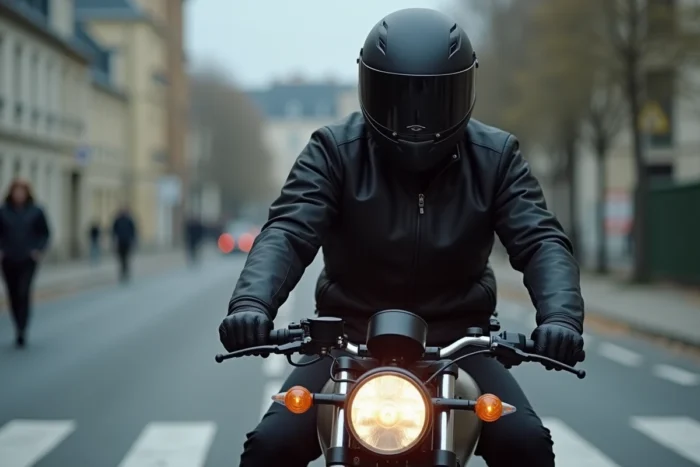
You change direction at a roundabout, instinctively signaling with your indicator. Next to you, a motorcyclist simply extends their arm. Who is in the right? The answer depends on the category of the two-wheeler, its date of first registration, and, recently, the technical inspection.
Motorcycle Technical Inspection and Indicators: A Requirement That Became Concrete in 2024
Most discussions about motorcycle indicators revolve around the Highway Code. However, a less visible angle deserves attention: the technical inspection indirectly makes indicators mandatory for a large part of the fleet.
Since April 2024, technical inspection has become mandatory for motorcycles and scooters over 125 cm³. Among the points checked is a section on “Lighting and Signaling” that includes turn signals. Inspection centers place the verification of indicators on the same level as that of brakes and stop lights.
To better understand the legal framework surrounding the mandatory motorcycle indicator according to regulations, two situations must be distinguished. A vehicle subject to technical inspection must have functioning indicators to obtain its compliance. A vehicle not subject to inspection (for example, under 125 cm³) remains governed by the Highway Code, but without this periodic verification safety net.
This distinction creates a practical discrepancy. On an old 50 cm³ scooter, riding without a functioning indicator will only be detected during a roadside check. On a large-displacement motorcycle, the issue will automatically arise during the visit to the authorized center.
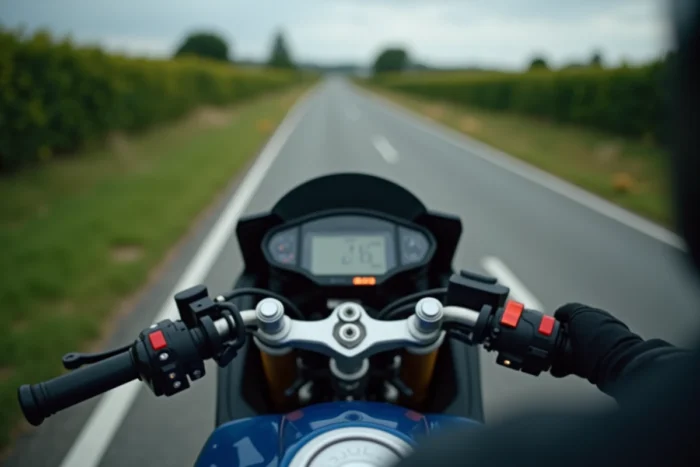
Date of First Registration: The Criterion That Changes Everything for Turn Signals
You have acquired an old motorcycle and are wondering if indicators are required? The registration date on the gray card settles the question.
Two-wheelers registered before a certain date were not originally required to be equipped with indicators. The decree of July 16, 1954, constitutes the historical regulatory basis. Vehicles prior to this period, or certain collectible models, can operate without turn signals as long as the driver signals their intentions with an arm gesture.
For more recent motorcycles, homologation requires the presence of front and rear indicators from the factory. Removing these turn signals, even for aesthetic reasons (custom, café racer), amounts to riding with a vehicle that does not comply with its original homologation.
Vehicles Subject to the Indicator Requirement
- Motorcycles and scooters of all displacements registered after the 1950s must have indicators that comply with their homologation certificate
- Recent mopeds (50 cm³) are subject to the same requirement, even if technical inspection does not yet apply to them
- Classic motorcycles prior to the regulations can do without them, provided the driver manually signals each change of direction
Road and Insurance Penalties: The Cost of an Absent or Defective Indicator
Riding without a functioning indicator exposes you to a fine. The lack of signaling is penalized by a fixed fine of 135 euros. This offense falls under a third-class violation.
The financial penalty is not the only risk. In the event of an accident occurring during a change of direction without signaling, the motorcyclist’s liability can be significantly more serious. The insurance may invoke the lack of equipment to reduce or deny compensation.
The Rhône Gendarmerie regularly reminds that indicators are a device intended to signal the driver’s intentions to other road users. The authorities consider the absence of an indicator as an aggravating factor when analyzing an accident, beyond mere verbalization.
Cascade Consequences of a Defective Indicator
- Fixed fine that can lead to a third-class violation
- Refusal of compliance at technical inspection for motorcycles over 125 cm³
- Unfavorable sharing of liability in the event of a claim, with a direct impact on insurance compensation
- Possible immobilization of the vehicle during a roadside check if the equipment is deemed dangerous
LED Indicators and Homologation: Replacing Without Losing Compliance
Many motorcyclists replace their original indicators with LED models, which are more compact and visible. This replacement is allowed, with one condition: replacement indicators must bear a European homologation marking (the letter “E” followed by a number in a circle).
A common pitfall concerns the flashing frequency. LED bulbs consume less energy than traditional bulbs. The motorcycle’s flasher unit, calibrated for a certain resistance, then detects an anomaly and speeds up the flashing rate. This phenomenon, called hyper-flash, produces an abnormally rapid blinking that may be considered non-compliant during an inspection.
The solution involves installing an appropriate resistor or replacing the flasher unit with a compatible LED model. Without this adjustment, the vehicle risks a refusal at the technical inspection or a remark during a roadside check.
The regulatory framework for motorcycle indicators rests on three pillars: the date of first registration of the vehicle, its original homologation, and, since 2024, the technical inspection for displacements over 125 cm³. Checking the condition and compliance of your turn signals before each season remains the simplest way to avoid an unpleasant surprise, whether facing a gendarme or at an inspection center.